
Since 2019
Multiple certifications
Global Export Reach
NACE TM0177-2024 covers SSC and SCC laboratory testing in H2S environments, with Methods A–D, revised procedures and material qualification reporting.
NACE MR0175-2021 / ISO 15156:2020 combines all three parts for sour-service material selection, covering carbon steel, duplex stainless steel, CRAs and qualification.
ISO 15156-3:2020 covers CRA and duplex stainless steel selection for H2S sour service, including environmental limits, PREN, welding and qualification.
ISO 15156-2:2020 covers carbon and low-alloy steel selection for H2S sour service, including SSC qualification, hardness, welding and HIC assessment.
A practical EU CBAM guide for stainless steel pipe exporters covering CN codes, 2026–2027 deadlines, embedded carbon calculations, verification, certificate costs and supply-chain strategies.
ISO 15156-1:2020 explains the general principles for selecting and qualifying cracking-resistant metallic materials in H2S-containing oil and gas production environments.
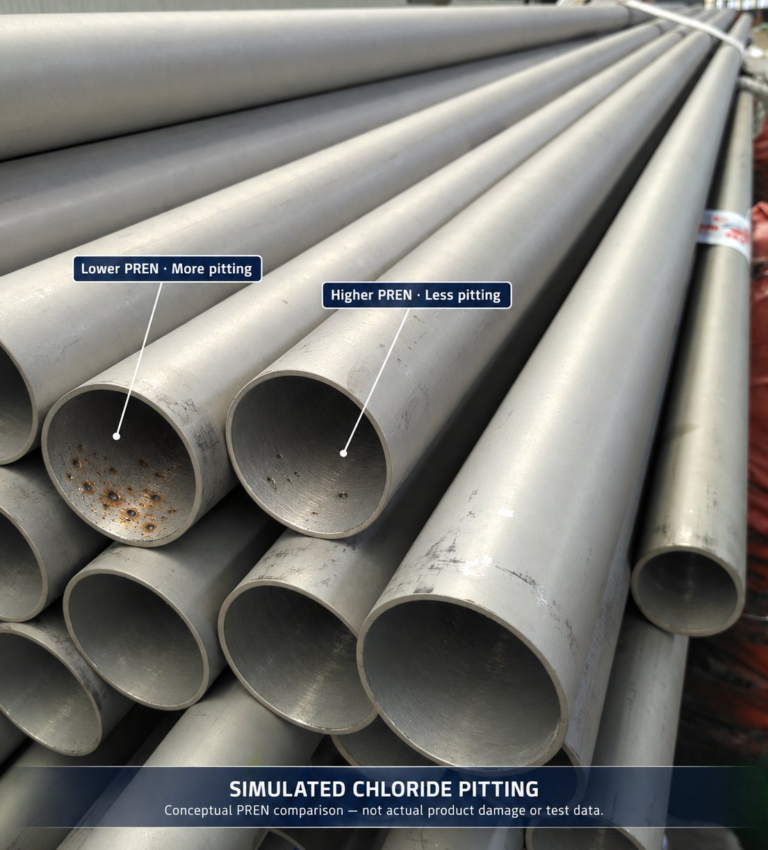
Duplex resists chloride SCC better than 304L/316L but is not immune. Compare 2205 and super duplex, PREN, weld condition and ISO 15156 sour-service limits.
Mechanical Properties of Duplex and Super Duplex Stainless Steel Pipe ASTM A790/A790M-24 specifies minimum yield strengths of 400 MPa for 2304, 450 MPa for 2205 and 550 MPa for 2507 stainless steel pipe. These strength levels can support lighter piping designs, provided the selected grade, wall thickness and service conditions satisfy the applicable design code. This guide compares the mechanical requirements of UNS S32304, S31803, S32205 and S32750, explains how to interpret the data, and identifies the design and fabrication factors that affect actual pipe performance. Request a Quote ASTM A790 Mechanical Properties: 2304 vs. 2205 vs. 2507 The following…
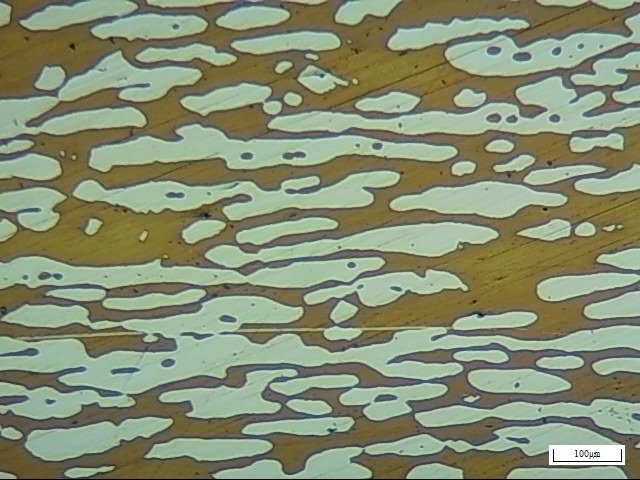
Compare duplex 2205 (S32205) and super duplex 2507 (S32750) stainless steel pipe by chemistry, PREN, specified strength, corrosion resistance, welding requirements and material selection.
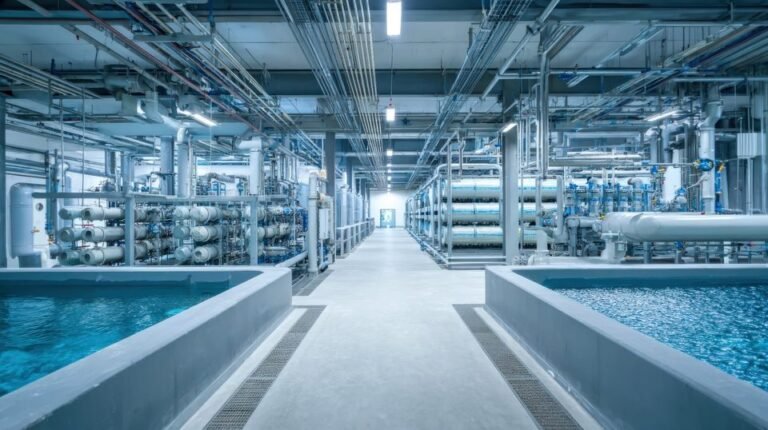
Where duplex seamless pipes are used, how standard duplex UNS S32205 compares with super duplex UNS S32750/S32760 (PREN, chemistry, mechanical properties), and the market and technology trends shaping future demand.
中国国家标准:钢管验收、捆扎包装、涂层防护、标志与质量证明书的通用规定。
中国国家标准:双相不锈钢无缝钢管(油气输送用)的牌号、性能与腐蚀验收要求。
中国国家标准:双相不锈钢无缝钢管(流体输送用)的牌号、性能与高温屈服强度。
中国国家标准:双相不锈钢无缝钢管(热交换器用)的牌号、性能与高温屈服强度。
中国国家标准:钢管尺寸系列、偏差等级、弯曲度、不圆度与重量偏差的通用规定。
中国国家标准:锅炉和热交换器用奥氏体不锈钢焊接钢管的技术要求与试验方法。
中国国家标准:锅炉、热交换器用不锈钢无缝钢管的牌号、性能、高温屈服强度与检验要求。
中国国家标准:输送流体用不锈钢无缝钢管的牌号、热处理、化学成分、力学性能与试验要求。
Standard specification for precipitation hardened or cold worked, seamless nickel alloy pipe and tube
Standard specification for general requirements for nickel and nickel alloy seamless pipe and tube
Standard specification for seamless uns n08020, uns n08026, and uns n08024 nickel-alloy pipe and tube
Standard specification for welded uns n06625, uns n06219, and uns n08825 alloy tubes
Standard specification for seamless nickel and nickel-cobalt alloy pipe and tube
Standard specification for nickel-chromium-molybdenum-columbium alloys (uns n06625 and uns n06852) and nickel-chromiummolybdenum-silicon alloy (uns n06219) pipe and tube
Standard specification for nickel-iron-chromium-molybdenum-copper alloy (uns n08825, n08221, and n06845) seamless pipe and tube
Standard specification for nickel-iron-chromium alloy seamless pipe and tube
Standard specification for nickel-chromium-iron alloys (uns n06600, n06601, n06603, n06690, n06693, n06025, n06045, and n06696), nickelchromium-cobalt-molybdenum alloy (uns n06617), and nickel-iron-chromium-tungsten alloy (uns n06674) seamless pipe and tube
Standard specification for nickel-copper alloy (uns n04400)* seamless pipe and tube
Standard specification for seamless nickel and nickel alloy condenser and heat-exchanger tubes
Standard specification for nickel seamless pipe and tube
Standard specification for general requirements for alloy and stainless steel pipe
Standard specification for seamless and welded ferritic/austenitic stainless steel pipe
Specification for seamless and welded ferritic/austenitic stainless steel tubing
Standard specification for seamless, welded, and heavily cold worked austenitic stainless steel pipes
Standard specification for seamless and welded austenitic and ferritic-austenitic stainless steel sanitary tubing
Standard specification for seamless and welded austenitic stainless steel tubing
Standard specification for seamless ferritic and austenitic alloy-steel boiler, superheater, and heat-exchanger tubes
Standard specification for seamless ferritic and austenitic alloy-steel boiler, superheater, and heat-exchanger tubes
Standard specification for general requirements for ferritic alloy steel, austenitic alloy steel, and stainless steel tubes
Seamless steel tubes for pressure purposes - technical delivery
conditions - part 5: stainless steel tubes
Seamless steel tubes for pressure purposes - technical delivery
conditions - part 4: non-alloy and alloy steel tubes with specified low temperature properties
Seamless steel tubes for pressure purposes - technical delivery conditions - part 3: alloy fine grain steel tubes
Seamless steel tubes for pressure purposes - technical delivery conditions - part 2: non-alloy and alloy steel tubes with specified elevated temperature properties
Seamless steel tubes for pressure purposes - technical delivery conditions - part 1: non-alloy steel tubes with specified room temperature properties
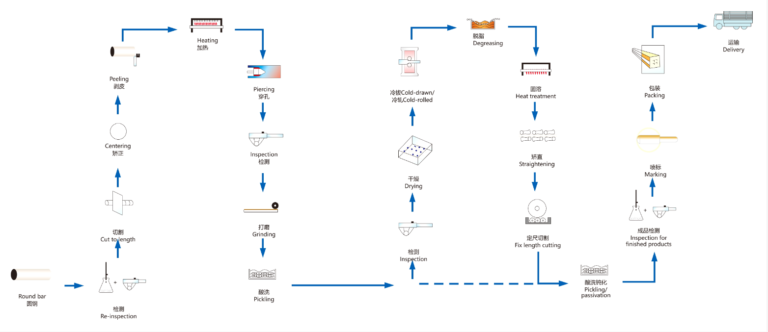
Step-by-Step Stainless Steel Seamless Pipe Manufacturing Process All the steps have been explained in detail below — follow the process flow from the raw round bar to the final marked pipe. Every seamless stainless steel pipe we produce passes through 20 controlled manufacturing steps, each with its own inspection or quality checkpoint, so that the finished product arrives weld-seam free, dimensionally accurate and traceable. Request a Quote Process Flow at a Glance Round Bar→Re-inspection→Cut to Length→Centering→Peeling→Heating→Piercing→Inspection→Grinding→Pickling→Drying→Cold Drawing / Rolling→Degreasing→Heat Treatment→Straightening→Fixed Length Cutting→Passivation→Final Inspection→Marking 1 Round Bar Selection This is the first step towards manufacturing seamless products at Xintongda. We select…
Why 304 Stainless Steel Pipes Are Widely Used In the modern industrial landscape, AISI 304 stainless steel (UNS S30400) is the undisputed “King of Usage.” Whether it is for high-precision sanitary tubing, industrial heat exchangers, or architectural structural components, the 304 grade remains the industry standard. But what specific properties make this Austenitic stainless steel the “Hexagon Warrior” of materials? Below, we analyze the technical and economic factors driving its global dominance. In this guide 1. The “Golden Ratio” of Chemical Composition 2. Exceptional Fabricability and Weldability 3. Cost-Effectiveness: Balancing Lifecycle and CAPEX 4. Regulatory Compliance and Sanitary Standards Technical Comparison: 201 vs. 304…
Understanding Incoloy and Inconel Pipes In high-temperature and corrosive industrial environments, choosing the correct nickel alloy pipe material is essential for ensuring long service life and system safety. Two of the most widely used nickel-based alloys are Incoloy and Inconel. Although both alloys belong to the family of nickel-based austenitic superalloys, their chemical compositions, mechanical performance, and industrial applications differ significantly. Understanding the difference between Incoloy and Inconel pipes helps engineers select the best material for industries such as oil & gas, petrochemical processing, aerospace, marine engineering, and power generation. In this guide What Is Inconel? What Is Incoloy? Incoloy vs Inconel: Chemical Composition Inconel vs Incoloy Pipe: Performance…