
Are Duplex Pipes Immune to Chloride SCC and Sour Service Cracking?
No. Duplex stainless steel pipes generally offer better resistance to chloride stress corrosion cracking than conventional 304L and 316L stainless steels, but they are not immune. Sour-service suitability requires a separate assessment of the alloy, metallurgical condition, welded joints and actual H₂S-containing environment.
For engineers and buyers, selection involves three distinct checks: localized corrosion resistance, environmental cracking resistance, and compliance with the applicable product specification and design requirements. A duplex grade designation or high PREN does not establish all three.
Request a Duplex Pipe QuotationWhy Duplex Stainless Steel Resists Chloride SCC
Stress corrosion cracking (SCC) requires a susceptible material, a relevant corrosive environment and tensile stress. The stress can include operating loads and residual stresses from welding, forming or assembly.
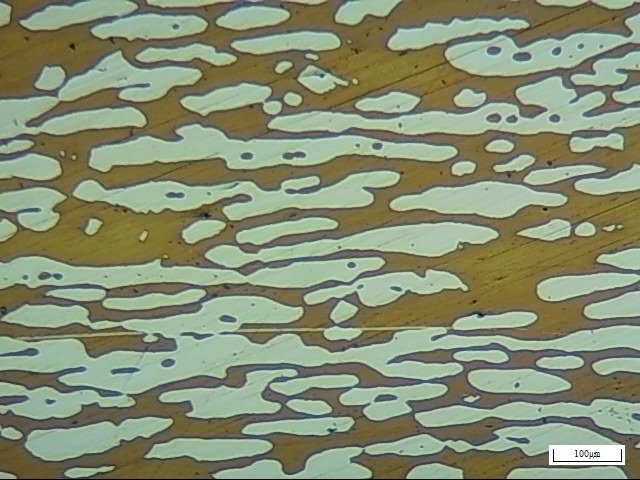
Duplex stainless steels have an austenitic-ferritic microstructure that provides substantially better chloride SCC resistance than conventional austenitic grades. However, aggressive laboratory environments, including concentrated boiling magnesium chloride solutions, can still produce cracking. Nickel Institute, Practical Guide to Using Duplex Stainless Steels
The useful selection question is therefore: which alloy, in which material condition, under which exposure and stress?
Is There a Safe Temperature or Chloride Limit?
There is no universal temperature or chloride concentration below which every duplex pipe is safe from SCC.
| Variable | Engineering significance |
|---|---|
| Temperature | Changes corrosion and cracking behavior; the most severe cracking condition may occur below the maximum operating temperature. |
| Chloride concentration | Specify the aqueous concentration and units. Bulk measurements may not represent concentrations beneath deposits, within crevices or at evaporating surfaces. |
| pH | For sour-service selection, identify the in situ pH of the water phase rather than relying solely on a cooled laboratory sample. |
| Oxygen, oxidants and elemental sulfur | Identify their presence because they can change environmental severity and the applicability of published data. |
| Tensile stress | Include applied and residual stress; consider forming and assembly as well as pressure loads. |
| Material condition | Identify heat treatment, cold work, microstructure and weld condition. |
| Exposure history | Include start-up, shutdown, process upsets and chemical treatments, where relevant. |
These sour-service variables are addressed in ISO 15156-3:2020, Clause 5 and 6.1. Table B.1 also warns that duplex cracking sensitivity can be greatest below the maximum service temperature. [1]
Caution: Published SCC diagrams are useful screening tools, but their boundaries depend on the specimen condition, loading, chemistry and exposure time. A result showing no cracking does not prove freedom from pitting or crevice corrosion, and it should not be converted into a general design temperature.
What PREN Can—and Cannot—Tell You
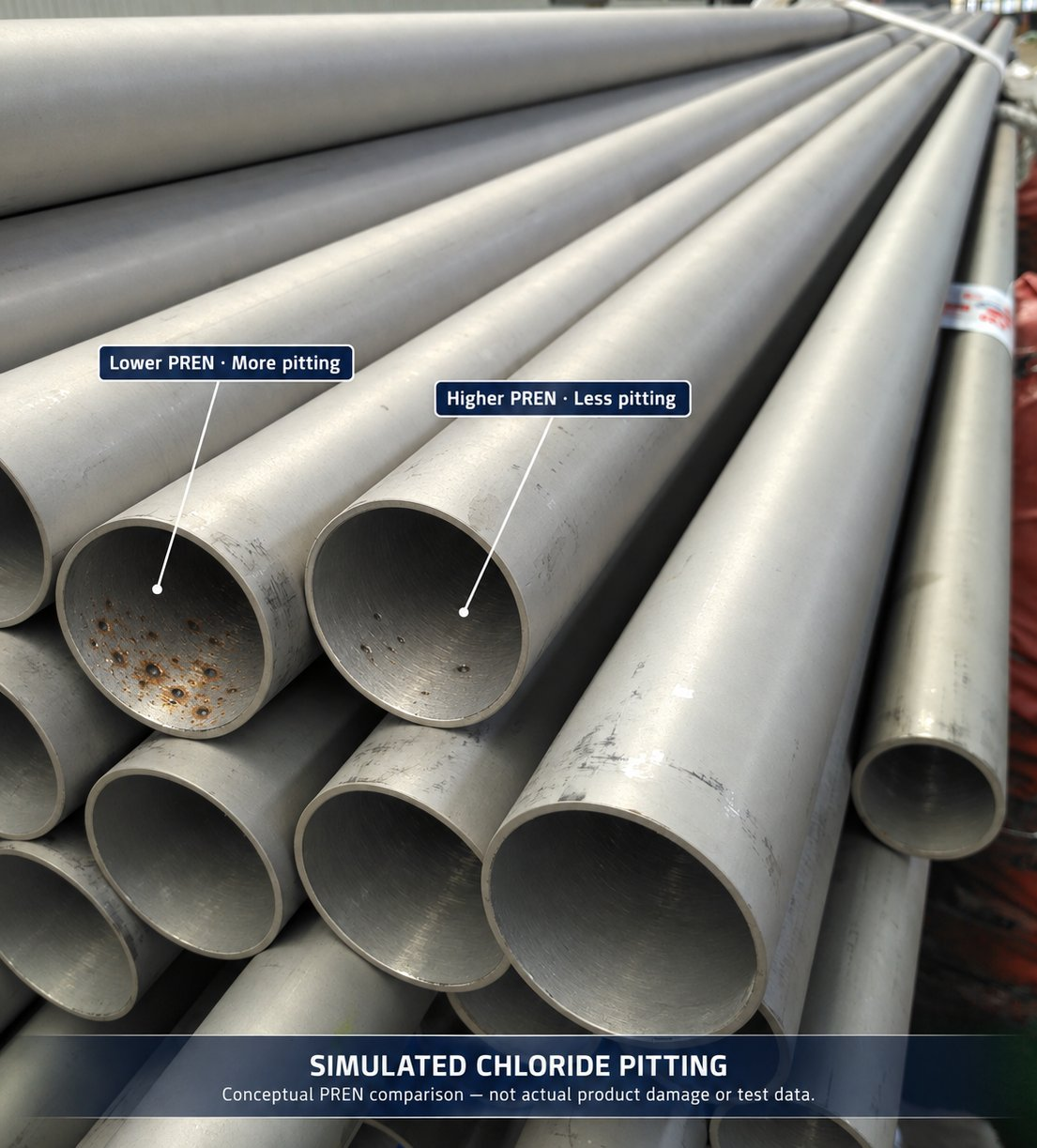
The Pitting Resistance Equivalent Number (PREN) is a composition-based index used to compare chloride pitting resistance. A commonly used expression is:
PREN = %Cr + 3.3 × %Mo + 16 × %N
For conformance assessment under ISO 15156-3:2020, Clause 6.3 specifies the tungsten-inclusive expression:
FPREN = %Cr + 3.3 × (%Mo + 0.5 × %W) + 16 × %N
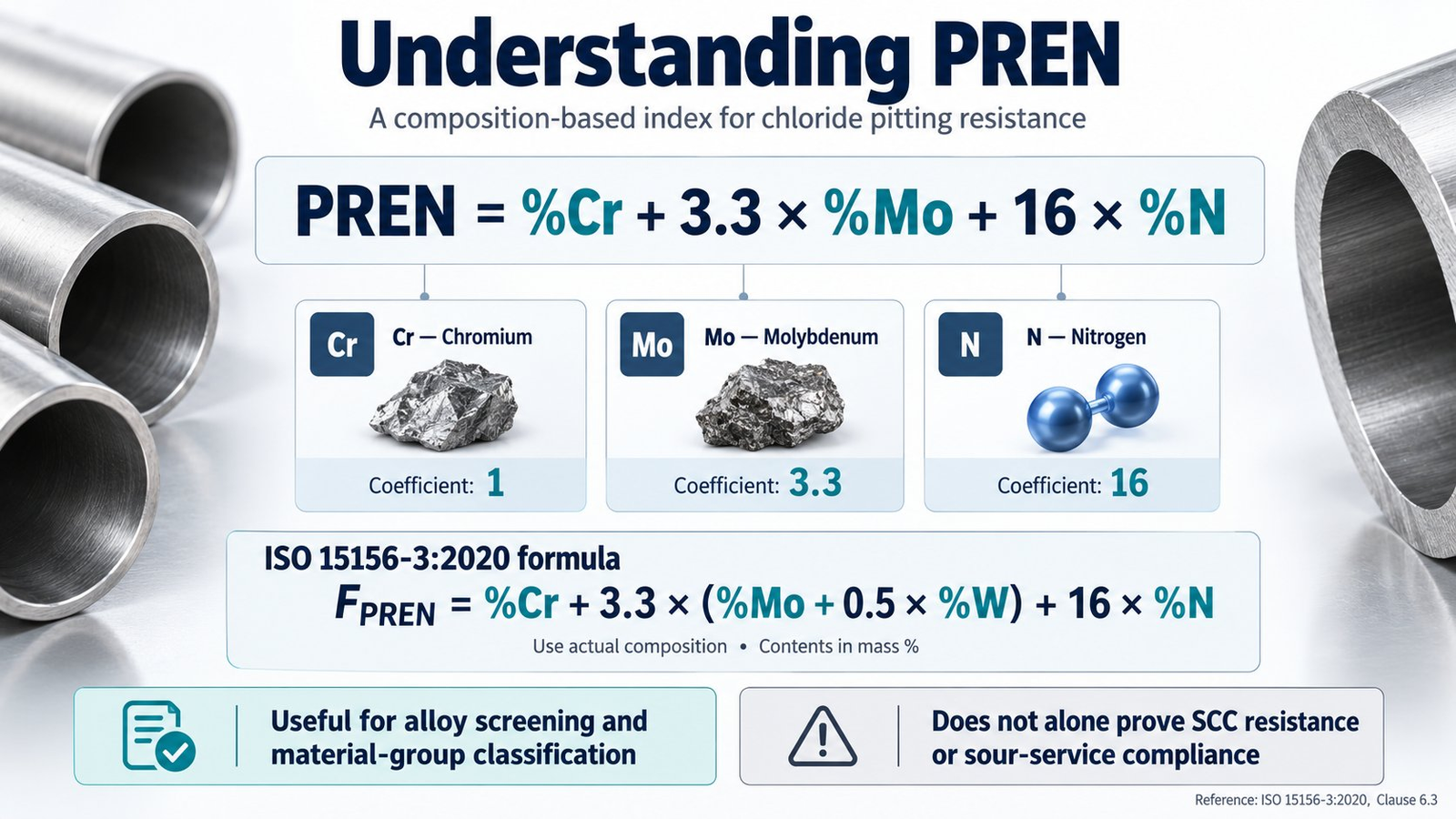
The element contents are percentages by mass. The standard requires calculation from actual composition, rather than nominal grade composition, and comparison with its absolute limits without rounding the result. [1]
This distinction matters: ISO 15156-3 uses F_PREN ranges to define duplex material groups in Annex A. PREN therefore has a role in standards assessment, but it is not an independent sour-service qualification or a direct SCC rating. Material condition, environmental limits and the applicable table must also be satisfied.
Remember: A calculated PREN is not a measurement of the corrosion resistance of a finished weld or heat-affected zone. Fabrication can alter the microstructure and local performance even when the bulk chemical composition remains unchanged.
2205 vs. Super Duplex Pipe: What Changes?
| Material | Common UNS designation | Selection relevance |
|---|---|---|
| 316L stainless steel | S31603 | A conventional austenitic comparison grade that can be susceptible to chloride SCC. |
| 2205 duplex | S31803 or S32205 | Often considered where greater chloride SCC resistance is required. Specify the exact UNS designation — see 2205 S32205 seamless pipe. |
| 2507 super duplex | S32750 | A higher-alloyed candidate for more demanding chloride exposure — see 2507 S32750 seamless pipe. |
| Super duplex | S32760 | Another candidate for demanding service — see S32760 seamless pipe; assess its own composition, delivery condition and qualification. |
S31803 and S32205 should not be treated as interchangeable purchasing descriptions. Alleima identifies its SAF 2205 chemistry as lying within the S32205 range, optimized within the broader S31803 range; acceptance of a supplied heat must follow the specified grade and product requirements. Alleima, SAF 2205 seamless tube and pipe datasheet
Upgrading to super duplex can improve localized corrosion resistance, but it does not establish an unrestricted sour-service envelope. The relevant ISO 15156 material group and application requirements still govern the assessment.
Duplex Pipe in Sour Service: What ISO 15156 Covers
ISO 15156-3 addresses cracking-resistant corrosion-resistant alloys and other alloys for H₂S-containing oil and gas production equipment and natural gas treatment plants. It addresses sulfide stress cracking (SSC), stress corrosion cracking (SCC) and galvanically induced hydrogen stress cracking (GHSC). [1]
Its scope does not assess material loss from general corrosion, pitting or crevice corrosion. Consequently, acceptance for cracking resistance under ISO 15156 does not establish adequate localized corrosion resistance for the process fluid.
The standard supplements applicable design requirements. It is not necessarily suitable for refining or downstream equipment, so a project must identify the appropriate sour-service standard rather than applying MR0175 to every process containing H₂S. ISO 15156-3 official scope
The clause references in this article use ISO 15156-3:2020. Purchase specifications should state the contractually applicable ISO 15156/NACE MR0175 edition and any applicable corrections or amendments.
Read the Applicable Table, Material Condition and Footnotes Together
ISO 15156-3:2020, Annex A.7 distinguishes between duplex material conditions and applications. [1]
| Provision | Application and condition | Assessment implication |
|---|---|---|
| Table A.24 | Duplex steels for any equipment or component, subject to the specified solution-annealing and rapid-cooling requirements | Match the actual F_PREN material group and the complete environmental row, including remarks and footnotes. |
| Table A.25 | Downhole tubular components, packers and other subsurface equipment in the specified solution-annealed, liquid-quenched and cold-worked condition | Use the requirements for this application and condition; do not transfer them to generic process pipe. |
| A.7.2 and 6.2.2 | Duplex welded joints and welding procedure qualification | Assess weld metal, heat-affected zone and parent metal as required. Base-metal acceptance alone is insufficient. |
Tables A.24 and A.25 both specify a base-material ferrite volume fraction of 35% to 65% for their respective conditions. Table A.25 additionally specifies a maximum hardness of 36 HRC for its covered cold-worked subsurface applications. These requirements should not be generalized into a universal duplex-pipe acceptance rule. [1]
Two table-reading errors are particularly consequential:
- A remark that sets no individual limit does not necessarily mean every combination of temperature, H₂S partial pressure and pH is acceptable. Table A.24 expressly qualifies some such combinations.
- NDS in the elemental-sulfur column means that data were not submitted to establish acceptability in the presence of elemental sulfur. It is not confirmation of sulfur resistance.
A claim such as “2205 is acceptable up to 5 psia H₂S” or “all duplex must be below 32 HRC” is therefore incomplete without a specified application, material condition and acceptance basis.
Why Welds and Fabrication Matter
Welding and subsequent fabrication can change the microstructure, hardness and cracking resistance. ISO 15156-3:2020, 6.2.2 recognizes that welded joints can be more susceptible than the parent material and requires supporting welding procedure documentation. [1]
For duplex welding procedure qualification, A.7.2 includes examination of weld metal, heat-affected zone and base metal. It specifies limits on detrimental phases and a 30% to 70% ferrite volume fraction in the weld-metal root and unreheated weld cap, determined in accordance with ASTM E562. This is distinct from the base-material range in Tables A.24 and A.25. [1]
The purchasing and fabrication review should therefore identify:
- The exact alloy, product form, delivery condition and heat traceability.
- Heat-treatment and any cold-work records relevant to acceptance.
- Welding procedure specifications and procedure qualification records covering the proposed fabrication.
- Required evidence for hardness, microstructure and cracking resistance.
- Project-specific corrosion testing, examination and acceptance criteria.
The required controls should follow the applicable standard and contract. Additional production tests should be specified explicitly rather than inferred from the word “duplex.”
When Is Additional Qualification Needed?
ISO 15156-3:2020, 6.1 permits selection using Annex A, laboratory qualification under Annex B, or satisfactory field-experience qualification conforming to ISO 15156-1. Clause 6.1 also permits testing to qualify conditions more severe than Annex A limits or different metallurgical conditions. Supporting qualifications must be verified and documented. [1]
An exposure outside an Annex A limit therefore requires a valid alternative qualification basis; a supplier statement or unrelated test result does not provide one.
For duplex, qualification should account for the relevant cracking mechanisms and temperature range. Testing only at the maximum operating temperature can miss a more susceptible lower-temperature condition, as highlighted in Table B.1. [1]
Which Tests Are Relevant?
| Assessment | Relevant approach | What the result establishes |
|---|---|---|
| Chloride pitting or crevice corrosion | An appropriate ASTM G48 method, with specified conditions and acceptance criteria | Localized corrosion performance under the selected test; not independent sour-service cracking qualification. |
| Cracking in an H₂S environment | Applicable environmental cracking methods, potentially including NACE TM0177, within the required qualification framework | Resistance under the documented specimen, loading and environmental conditions. |
| Weld suitability for sour service | ISO 15156-3 welding requirements and the applicable Annex A or Annex B basis | Evidence for the qualified weld condition and exposure, within the documented scope. |
ASTM G48 specifically concerns ferric-chloride pitting and crevice-corrosion testing. Its test temperature should not be presented as a universal service temperature. ASTM corrosion standards listing
For an environmental cracking report, review the specimen location and condition, solution chemistry, H₂S exposure, temperature, stress or loading method, test duration and acceptance criteria. A “pass” has meaning only within that documented scope.
Information Needed Before Selecting Duplex Pipe
| Category | Information to provide |
|---|---|
| Process envelope | Normal, minimum and maximum temperatures; pressure; credible start-up, shutdown and upset conditions. |
| Water-phase chemistry | Chloride concentration with units, in situ pH and relevant dissolved constituents. |
| Sour exposure | H₂S partial pressure or an appropriate dissolved-concentration basis, with the pressure and composition assumptions identified. Total pressure or H₂S concentration alone does not define partial pressure. |
| Other exposure factors | Oxygen ingress, elemental sulfur, deposits, crevices, evaporation and relevant galvanic coupling. |
| Material and fabrication | Exact UNS grade, seamless or welded construction, product form, heat treatment, cold work and fabricated joints. |
| Acceptance basis | Product specification, design code, sour-service standard edition, selected table or qualification route, documentation and testing requirements. |
The supplier’s proposal should identify the material condition and acceptance basis against this defined envelope. A generic “NACE compliant” statement does not explain which service conditions or fabrication states are covered. For room-temperature strength data per grade, see our duplex stainless steel pipe mechanical properties overview.
Frequently Asked Questions
Is duplex stainless steel immune to chloride SCC?
No. Duplex generally resists chloride SCC better than conventional 304L and 316L, but aggressive exposures can still cause cracking. Grade, material condition, stress and chemistry must be assessed together.
Can 2205 duplex pipe be used in sour service?
Yes, where the specified material and application satisfy the applicable ISO 15156/NACE MR0175 requirements or have a valid documented qualification. The name “2205” alone does not establish acceptance.
Is super duplex automatically suitable for higher H₂S pressure?
No. Check the applicable F_PREN material group, component application, metallurgical condition, environmental row and qualification basis. Higher alloying does not provide unlimited sour-service resistance.
Does PREN above 40 prove sour-service compliance?
No. ISO 15156-3 uses F_PREN for material-group classification, but the calculation must use actual composition and the prescribed formula. All other applicable requirements remain necessary.
Does passing ASTM G48 prove MR0175 compliance?
No. G48 assesses localized corrosion under ferric-chloride test conditions. It does not independently qualify resistance to H₂S-related cracking.
What should the material documentation demonstrate?
It should support the specified grade, heat traceability, material condition and applicable acceptance requirements. Welding and qualification evidence may require separate records; a material certificate alone does not define the entire service envelope.
Need a Quotation for Duplex or Super Duplex Pipe?
Submit the required UNS grade, dimensions, quantity, product specification and service envelope. Include temperature, aqueous chloride concentration, in situ pH, H₂S partial pressure, fabrication requirements and the applicable sour-service standard edition. The quotation can then identify the proposed delivery condition, documentation and agreed testing requirements.
Send Your Specification for a QuoteTechnical Reference
- ISSF — worldstainless.org/wp-content/uploads/2021/11/ISSF_Duplex_Stainless_Steels.pdf
- Nickel Institute — nickelinstitute.org — A Practical Guide to Using Duplex Stainless Steels
- R. Francis — stainless-steel-world.net — Duplex stainless steels and chloride SCC: how resistant are they?
- ISO 15156-3 — iso.org/standard/66642.html
- Water UK IGN 4-25-02 — standards-board.water.org.uk — IGN 4-25-02
- OSTI-hosted study — osti.gov/etdeweb/servlets/purl/20671821
- Alleima — alleima.com — SAF 2205 seamless tube and pipe datasheet