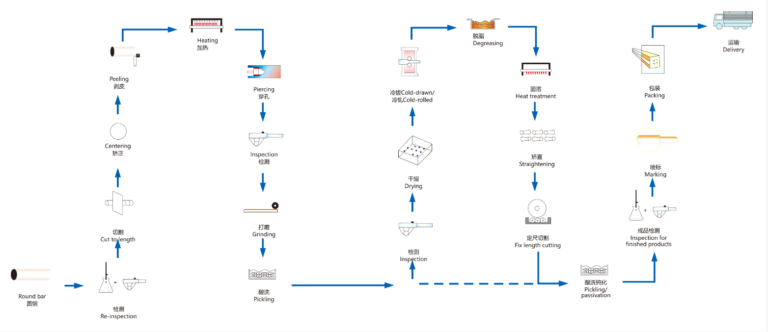

In the modern industrial landscape, AISI 304 stainless steel (UNS S30400) is the undisputed “King of Usage.” Whether it is for high-precision sanitary tubing, industrial heat exchangers, or architectural structural components, the 304 grade remains the industry standard.
But what specific properties make this Austenitic stainless steel the “Hexagon Warrior” of materials? Below, we analyze the technical and economic factors driving its global dominance.
1. The “Golden Ratio” of Chemical Composition
The performance of 304 stainless steel is rooted in its chemistry, specifically the 18/8 ratio (18% Chromium and 8% Nickel).
- Superior Corrosion Resistance: The high chromium content facilitates the formation of a self-healing passive oxide layer. This layer provides exceptional resistance to oxidation and corrosion in a wide range of environments, including atmospheric exposure and potable water systems.
- Cryogenic & High-Temperature Stability: Unlike ferritic steels that become brittle at low temperatures, the FCC (Face-Centered Cubic) crystal structure of 304 ensures excellent toughness from cryogenic temperatures up to approximately $870^\circ C$.
2. Exceptional Fabricability and Weldability
One of the primary reasons for the widespread adoption of 304 stainless steel pipes in manufacturing is their superior workability.
- Welding Performance: 304 grade is compatible with all standard welding techniques, including TIG (GTAW), MIG (GMAW), and SMAW. Its low carbon content (especially in the 304L variant) helps minimize carbide precipitation during welding, ensuring structural integrity.
- Ductility and Forming: With high elongation rates, 304 pipes can be easily subjected to cold working, such as bending, flaring, and deep drawing, without immediate work hardening or cracking.
3. Cost-Effectiveness: Balancing Lifecycle and CAPEX
From an Engineering, Procurement, and Construction (EPC) perspective, 304 stainless steel offers the optimal balance between Capital Expenditure (CAPEX) and Operational Expenditure (OPEX).
- Outperforming the 200 Series: While 201/202 series steels are cheaper due to lower nickel content, they are prone to pitting corrosion and stress corrosion cracking. 304 provides a significantly longer service life, reducing replacement cycles.
- The 316 Alternative: 316 stainless steel includes 2-3% Molybdenum (Mo), which is essential for marine or high-chloride environments. However, for 90% of inland industrial and commercial applications, 316 is an unnecessary expense. Choosing 304 typically saves 30% to 50% in material costs while meeting all safety and durability requirements.
4. Regulatory Compliance and Sanitary Standards
304 stainless steel is globally recognized for its biocompatibility and non-reactive surface, making it the benchmark for regulated industries:
- Food & Beverage: Meets stringent FDA and NSF standards for food contact.
- Medical & Pharma: Resistant to the harsh chemicals used in sterilization and cleaning processes.
- Water Treatment: The preferred material for urban water supply systems to prevent secondary pollution.
Technical Comparison: 201 vs. 304 vs. 316 Stainless Steel
| Property | 201 (Lower Grade) | 304 (Standard) | 316 (Marine Grade) |
| Chemical Formula | 17Cr-4.5Ni-6Mn | 18Cr-8Ni | 16Cr-10Ni-2Mo |
| Corrosion Resistance | Low (Indoor only) | High (General purpose) | Superior (Chloride resistant) |
| Weldability | Moderate | Excellent | Good |
| Typical Application | Decorative trim, kitchenware | Piping, Industrial, Food | Marine, Chemical, Medical |
| Relative Cost | $ | $$ | $$$ |
Conclusion
The dominance of 304 stainless steel pipes is not the result of a single “best” feature, but rather its versatility. It provides a “safe” engineering choice that satisfies mechanical requirements, regulatory standards, and budget constraints simultaneously.
For engineers and buyers, 304 is the reliable “white shirt” of the metals industry—appropriate for almost any occasion and built to last.