
ASTM A790/A790M-24 specifies minimum yield strengths of 400 MPa for 2304, 450 MPa for 2205 and 550 MPa for 2507 stainless steel pipe. These strength levels can support lighter piping designs, provided the selected grade, wall thickness and service conditions satisfy the applicable design code.
This guide compares the mechanical requirements of UNS S32304, S31803, S32205 and S32750, explains how to interpret the data, and identifies the design and fabrication factors that affect actual pipe performance.
Request a QuoteASTM A790 Mechanical Properties: 2304 vs. 2205 vs. 2507
The following values are specified minimum tensile properties and maximum hardness limits from ASTM A790/A790M-24, Table 3.
| Grade / common designation | UNS number | Minimum yield strength, MPa [ksi] | Minimum tensile strength, MPa [ksi] | Minimum elongation¹ | Maximum hardness, HBW / HRC |
|---|---|---|---|---|---|
| Lean duplex 2304 | S32304 | 400 [58] | 600 [87] | 25% | 290 / 30 |
| Duplex, commonly associated with 2205 | S31803 | 450 [65] | 620 [90] | 25% | 290 / 30 |
| Duplex 2205 | S32205 | 450 [65] | 655 [95] | 25% | 290 / 30 |
| Super duplex 2507 | S32750 | 550 [80] | 800 [116] | 15% | 300 / 32 |
¹ Elongation is specified over a 2 in. or 50 mm gauge length.
How to use this table:
- These are specification limits, rather than typical mill results or design allowable stresses.
- S31803 and S32205 have different minimum tensile strengths. Specify the required UNS number instead of relying on “2205” alone.
- ASTM treats SI and inch-pound values as separate standard systems. Use the unit system specified in the purchase order.
- Confirm compliance against the contract edition and the material test report.
Source: ASTM A790/A790M-24, Table 3, page 5 of the standard. The specification’s scope and edition are available from ASTM International.
What Do These Mechanical Properties Mean?
Yield Strength
Yield strength indicates resistance to permanent deformation. For duplex pipe, it helps engineers assess pressure capacity and structural loading. However, minimum yield strength is not the allowable stress used for pressure design. The applicable code establishes allowable stresses and other design requirements for the material and temperature.
Tensile Strength
Tensile strength is the maximum engineering stress reached during a tensile test. It is important for material qualification but does not independently establish a pipe’s pressure rating. For example, S32205 and S31803 share a minimum yield strength of 450 MPa, while their minimum tensile strengths differ.
Elongation
Elongation measures the extension of a tensile specimen at fracture. It provides information about ductility under defined test conditions. Compare elongation values only when the gauge length, specimen geometry and test method are compatible. A lower specified elongation does not, by itself, establish whether a material is suitable for a particular piping system.
Hardness
Hardness testing helps verify the supplied material condition. Meeting a hardness limit alone does not confirm corrosion resistance, impact toughness or the absence of detrimental phases.
Mill Test Reports in Practice: 2205 vs 2507 Tensile Results
The specified minimums above describe the floor a heat must meet before it can be certified. The two tensile test reports below, from our own production of seamless duplex pipe, show how actual mill results compare with those limits.
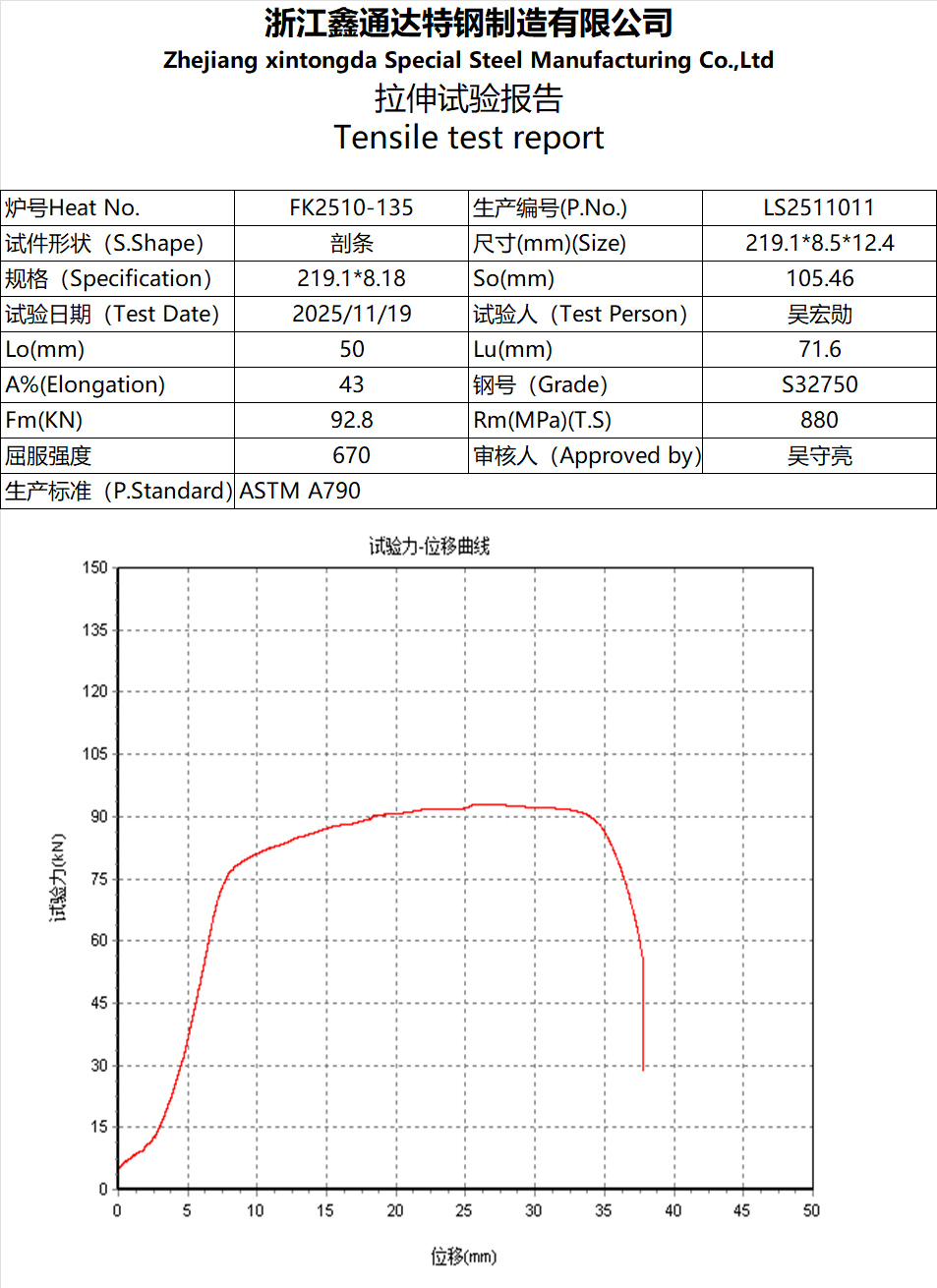
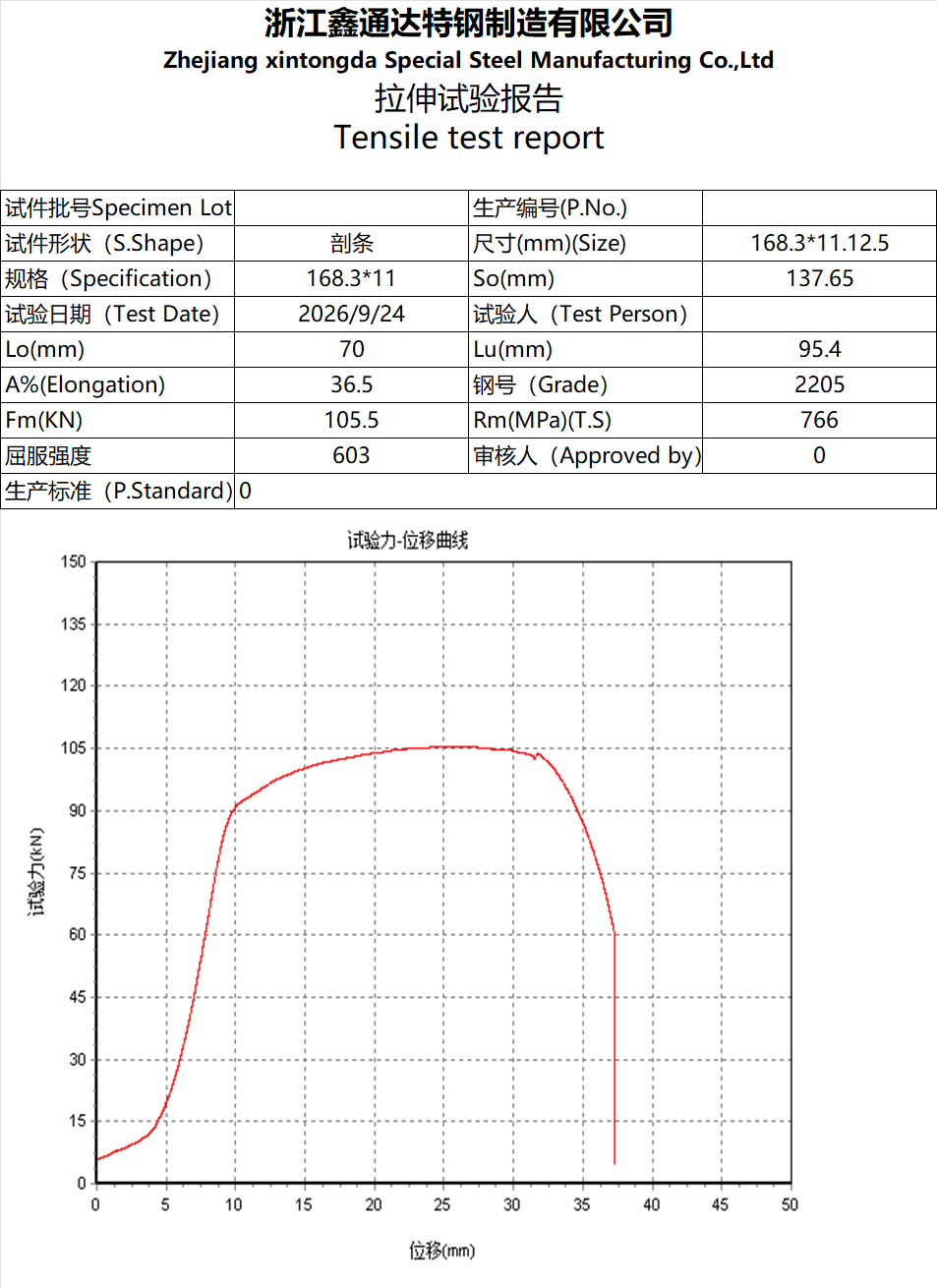
| Property | 2205 — specified minimum | 2205 — mill test report | 2507 — specified minimum | 2507 — mill test report |
|---|---|---|---|---|
| Yield strength | 450 MPa | 603 MPa | 550 MPa | 670 MPa |
| Tensile strength | 655 MPa | 766 MPa | 800 MPa | 880 MPa |
| Elongation in 2 in. / 50 mm | 25% | 36.5% | 15% | 43% |
Reading the reports: these results are from specific heats and sizes; actual values vary from heat to heat. Mill results above the specified minimum are normal for duplex grades. Per the purchase specification, reported strength above the minimum must not be used to increase design allowable stress unless the governing code expressly permits it.
Why Is Duplex Stainless Steel Strong?
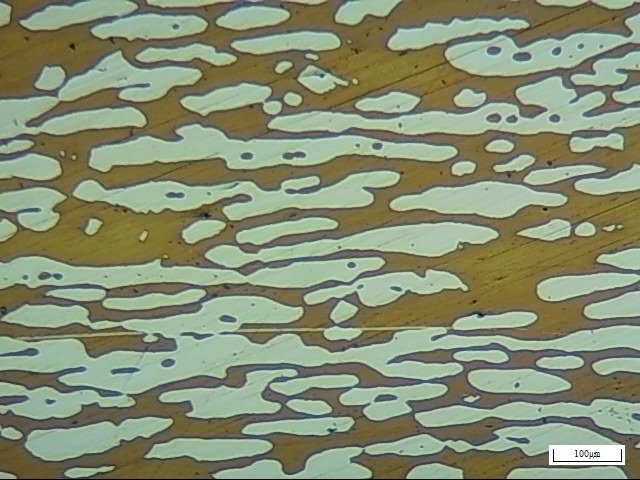
Duplex stainless steel contains both ferrite and austenite. Its balanced microstructure and alloying additions, including nitrogen, provide high strength while retaining useful ductility.
The structure is often described as approximately 50/50, but this is a general description rather than an exact acceptance criterion for every base metal and weld. Phase balance depends on composition, thermal history and processing — see the IMOA fabrication guide, Sections 3–4 and 12.1.8.
Can Duplex Pipe Reduce Wall Thickness?
Duplex pipe can permit a thinner wall when pressure design governs and the applicable code allows a higher design stress. A material substitution still requires a complete design review. Check the following before selecting a lower pipe schedule:
| Design factor | Why it matters |
|---|---|
| Allowable stress at design temperature | Room-temperature tensile data cannot replace code values |
| Internal and external pressure | Pressure containment and collapse require different checks |
| Weld and joint factors | Manufacturing route and joint requirements can affect calculations |
| Corrosion and erosion allowance | Required allowances remain part of wall sizing |
| Manufacturing wall tolerance | Nominal thickness must provide the required minimum wall |
| Bending, vibration and support loads | Loads beyond internal pressure may govern |
| Stiffness and buckling | Higher strength does not produce a proportional increase in stiffness |
| Available pipe schedules | Calculated savings may not translate into a commercially available size |
Where a thinner wall is feasible, potential benefits include lower pipe weight, easier handling and reduced weld volume.
Twice the yield strength does not automatically mean half the wall thickness. Evaluate the complete piping system, including fittings, flanges, fabrication and inspection costs. A first screening can be started with our pipe wall thickness calculator.
Fatigue and Corrosion Fatigue Performance
Duplex and super duplex stainless steels are used in cyclically loaded systems where strength and corrosion resistance are both important. Alleima identifies corrosion fatigue resistance as a characteristic of its SAF® 2507 seamless tube and pipe — see the Alleima SAF® 2507 datasheet.
There is no single fatigue-strength percentage that applies to every duplex piping application. Fatigue performance depends on:
- Stress range, mean stress and cycle count.
- Weld geometry, defects and residual stress.
- Surface finish, notches and local stress concentrations.
- Temperature, corrosive medium and exposure conditions.
- Loading frequency and the selected fatigue assessment method.
For pressure cycling, pump vibration or offshore service, use fatigue data and design curves appropriate to the material, environment and joint configuration. ASTM A790 tensile requirements do not establish a fatigue design curve.
Temperature and Impact Toughness
Room-temperature strength values are insufficient for assessing elevated-temperature or low-temperature service.
Prolonged exposure at elevated temperatures can cause duplex stainless steels to lose toughness through microstructural changes. ASTM A790/A790M-24 explicitly identifies susceptibility to embrittlement under prolonged elevated-temperature exposure.
For low-temperature service, establish the required impact-test temperature, specimen size and acceptance criteria under the governing code and project specification.
High tensile strength does not guarantee adequate impact toughness. Review the base metal, weld metal and heat-affected zone requirements separately.
Fabrication and Welding Considerations
Cold Forming and Machining
High duplex yield strength increases forming loads and springback. Select equipment capacity, tooling and machining parameters for the specific grade and product condition — see the IMOA fabrication guide, Sections 10–11.
Welding
Use a qualified welding procedure that controls heat input, interpass temperature, consumables and shielding.
IMOA gives general maximum interpass guidance of 150 °C for lean and standard duplex and 100 °C for super duplex. These are guidance values; the qualified procedure and project requirements govern production welding — see IMOA fabrication guide, Section 12.1.6.
Both insufficient and excessive heat input can impair the weld microstructure. The objective is acceptable phase balance, toughness and corrosion performance, rather than an exact 50/50 phase ratio — see IMOA fabrication guide, Sections 12.1.6–12.1.8.
What to Specify When Ordering Duplex Pipe
A clear purchase specification helps prevent grade ambiguity and incomplete documentation. Include:
- Material specification and edition: ASTM A790/A790M and the required UNS grade.
- Manufacturing route: seamless or welded pipe, with any project restrictions.
- Dimensions: NPS or outside diameter, schedule or wall thickness, length and tolerances.
- Service conditions: design temperature, pressure and relevant corrosive exposure.
- Inspection requirements: applicable standard tests and explicitly agreed supplementary tests.
- Certification: required material test report, heat identification and traceability.
Review reported chemistry, tensile properties, hardness and heat treatment against the specified requirements. When impact, corrosion or metallurgical testing is required, define the method and acceptance criteria in the order.
Actual mill strength above the specification minimum should not be used to increase design allowable stress unless the governing code expressly permits it.
Grade pages: see our S32205 (2205) seamless pipe, S31803 2205 pipe and S32750 (2507) seamless pipe to ASTM A790, or browse the ASTM standards library.
Frequently Asked Questions
What is the minimum yield strength of 2205 duplex pipe?
Under ASTM A790/A790M-24, both S32205 and S31803 have a minimum yield strength of 450 MPa [65 ksi]. Their minimum tensile strengths differ: 655 MPa [95 ksi] for S32205 and 620 MPa [90 ksi] for S31803.
Is 2507 stronger than 2205?
Yes. ASTM A790/A790M-24 specifies 550 MPa minimum yield strength and 800 MPa minimum tensile strength for S32750, compared with 450 MPa and 655 MPa for S32205. Corrosion suitability must also be assessed for the intended service.
Are S31803 and S32205 interchangeable?
Do not assume interchangeability. They are separate UNS designations with different specification requirements. Where dual certification is required, verify that the material satisfies both designations.
Why does ASTM specify 15% elongation for S32750?
The 15% value is the specified minimum measured over a 2 in. or 50 mm gauge length. Other datasheets may report elongation using different specimen conventions. Compare equivalent test conditions rather than attributing every difference to strength alone.
Can duplex replace 316L without changing the piping design?
A substitution requires review of pressure design, corrosion suitability, temperature, fabrication and component compatibility. Duplex may permit wall reduction, but the approved design determines the final thickness.
Does ASTM A790 compliance prove suitability for seawater service?
No. Specification compliance establishes conformity to defined material and product requirements. Seawater suitability also depends on temperature, chlorides, crevices, flow conditions, deposits and fabrication quality.
Request Duplex Pipe Data or a Quotation
For an ASTM A790 duplex or super duplex pipe quotation, provide the UNS grade, pipe dimensions, quantity, manufacturing route, specification edition and inspection requirements.
Ask for material test reports and available size information to support technical review and procurement.
Contact UsTechnical Reference
- [S1] ISSF — ISSF Duplex Stainless Steels
- [S2] IMOA — IMOA Duplex Stainless Steel
- [S3] Nickel Institute — A Practical Guide to Using Duplex Stainless Steel
- [S4] Alleima — SAF® 2507 datasheet
- [S5] ASTM A790 — Standard Specification for Seamless and Welded Ferritic/Austenitic Stainless Steel Pipe
- [S6] ASTM A789 — Standard Specification for Seamless and Welded Ferritic/Austenitic Stainless Steel Tubing for General Service