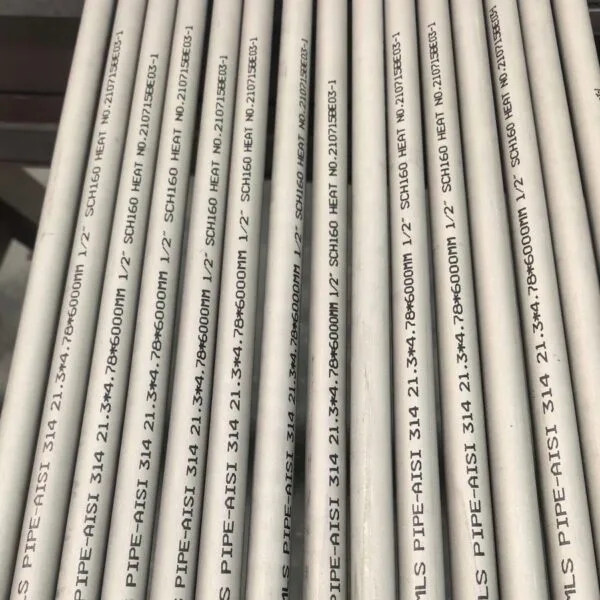
What is 314 (UNS S31400) seamless pipe?
TP314 (UNS S31400) is a 2 % silicon, 25 % Cr / 20 % Ni heat-resistant grade for seamless pipe in carburising, nitriding and oxidising furnace service. S31400 is not an A312 Table 1 grade, so the order is written against an agreed chemistry and annealing condition, with A312 referenced for dimensions and test methods. Supply NPS and schedule or OD × wall, the atmosphere and temperature, and the acceptance tests required.
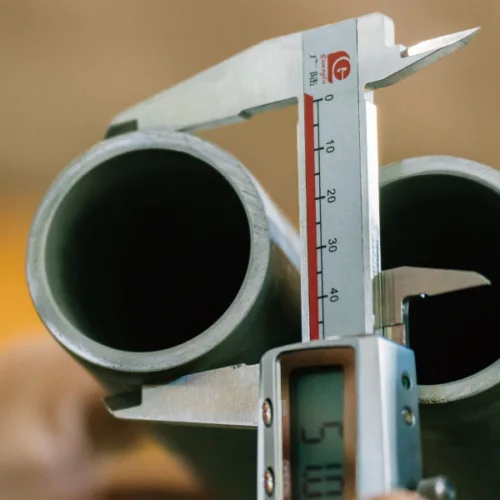
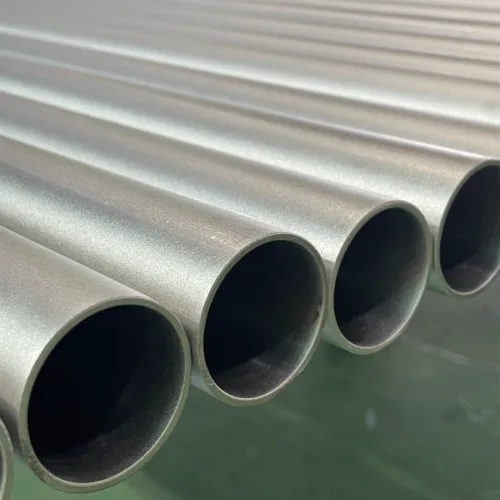
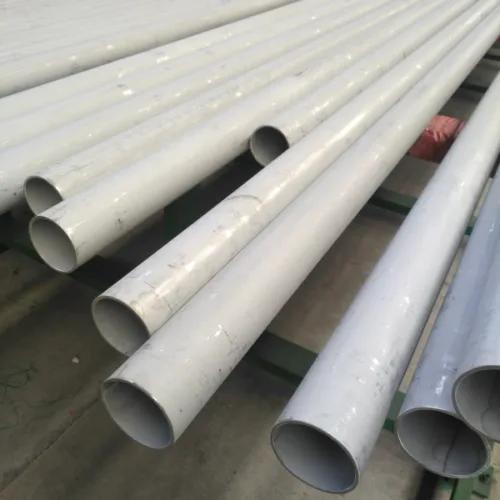
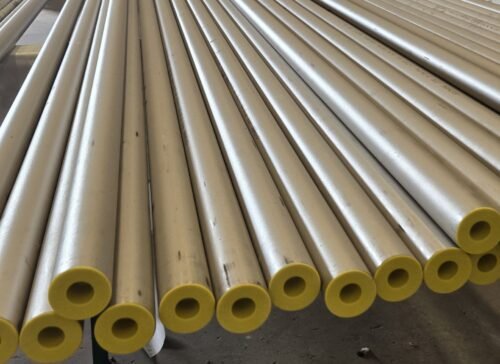
Manufactured from solid billets using hot piercing and precision rolling processes, TP314 seamless pipes feature:
- Fully homogeneous microstructure
- No weld seams or heat-affected zones (HAZ)
- Superior pressure resistance and structural reliability
Why Choose TP314 for High-Temperature Applications?
The defining feature of TP314 stainless steel is its elevated silicon (Si) content (1.50% – 3.00%), combined with high chromium and nickel levels. This unique composition:
- Forms a dense and stable oxide layer
- Significantly improves oxidation resistance
- Enhances mechanical stability at extreme temperatures
Compared to conventional grades like 304 or 316, TP314 is used in high-temperature oxidising atmospheres; the allowable service temperature depends on the atmosphere, cycling, stress and the design code, so any temperature limit is a material reference rather than a guaranteed service rating.
Key Advantages of TP314 Seamless Pipe
1. Exceptional Oxidation and Scaling Resistance
The high chromium (23–26%) and silicon content creates a protective oxide film, allowing long-term exposure to high-temperature oxidizing atmospheres without degradation.
2. Superior Creep and Rupture Strength
TP314 maintains excellent dimensional stability under sustained thermal stress, making it ideal for:
- Furnace components
- Heat treatment systems
- Continuous high-load environments
3. Seamless Structural Integrity
Seamless construction ensures:
- Higher pressure ratings
- Uniform wall thickness and strength
- No weld defects or localized corrosion risks
4. Excellent Thermal Stability
High nickel content improves:
- Resistance to thermal fatigue
- Stability under cyclic heating and cooling conditions
314 Pipe Specifications and Data
For 314 process piping, define heat-treatment and design basis, the applicable product specification and edition, dimensional basis, corrosion allowance where required by the design, end preparation and traceability. A nominal schedule alone does not establish an allowable working pressure.
Equivalent Grade
| UNS | Common grade name | EN material number | EN steel name | JIS grade | GB/T grade |
|---|---|---|---|---|---|
| S31400 | 314 | 1.4841 | X15CrNiSi25-21 | SUH 310 | 16Cr25Ni20Si2 (formerly 1Cr25Ni20Si2) |
Grade correspondence does not make ASTM, ASME, EN, JIS and GB delivery requirements interchangeable. Confirm chemistry, heat treatment, mechanical properties, dimensions, testing and certification against the purchase specification. See the grade designation index.
Chemical Composition
The unique properties of 314 stainless steel are largely due to its balanced composition, with silicon being a key element for high-temperature performance.
| C | Mn | P | S | Si | Cr | Ni |
|---|---|---|---|---|---|---|
| ≤0.25 | ≤2.00 | ≤0.045 | ≤0.030 | 1.50-3.00 | 23.00-26.00 | 19.00-22.00 |
Data source: Heat-analysis acceptance limits shown above are the values commonly specified for TP314 (S31400) high-silicon austenitic steel. Because TP314 is not listed in ASTM A312/A213/A269, the governing specification and edition are those agreed on the purchase order; always confirm the limits against that ordered edition and the mill test certificate (MTC).
Mechanical Requirements (agreed specification; A312/A312M-25 Table 4 used as reference)
Stainless Steel 314 is specifically designed to maintain its strength and shape in high-stress, high-temperature environments.
| Tensile Strength | Yield Strength | Elongation | Hardness |
|---|---|---|---|
| ≥ 520 MPa | ≥ 205 MPa | ≥ 40% | ≤ 217 HBW |
Note: Specified minimum values from the agreed product specification, using A312/A312M-25 Table 4 as reference; S31400 is not a listed A312 grade. They are acceptance requirements, not design allowables. Mechanical properties are reported on the MTC against the ordered standard, product form, condition and test temperature.
Typical Physical Properties
These physical properties highlight the material’s ability to perform reliably under a wide range of conditions.
| Density | Melting Point | Thermal Expansion | Thermal Conductivity | Modulus of Elasticity | Electrical Resistivity |
|---|---|---|---|---|---|
| 7.9 g/cm3 | 1390 – 1420 °C approx. | 16.5 μm/m·°C (20-100°C) | 14.2 W/m·K (20°C) | 200 GPa | 0.78 × 10⁻⁶ Ω·m (20°C) |
Note: Specified minimum values from the agreed product specification, using A312/A312M-25 Table 4 as reference; S31400 is not a listed A312 grade. They are acceptance requirements, not design allowables. Physical and mechanical properties are reported on the MTC against the ordered standard, product form and condition.
Size Tolerance Chart (A999/A999M-24a, in.)
| NPS Designator (Inches) | Permissible Variations in Outside Diameter (Inches) |
| 1⁄8 to 1 1⁄2, inclusive | Over: 1⁄64 in. (0.015 in.) |
| Under: 1⁄32 in. (0.031 in.) | |
| Over 1 1⁄2 to 4, inclusive | Over: 1⁄32 in. (0.031 in.) |
| Under: 1⁄32 in. (0.031 in.) | |
| Over 4 to 8, inclusive | Over: 1⁄16 in. (0.062 in.) |
| Under: 1⁄32 in. (0.031 in.) | |
| Over 8 to 18, inclusive | Over: 3⁄32 in. (0.093 in.) |
| Under: 1⁄32 in. (0.031 in.) | |
| Over 18 to 26, inclusive | Over: 1⁄8 in. (0.125 in.) |
| Under: 1⁄32 in. (0.031 in.) | |
| Over 26 to 34, inclusive | Over: 5⁄32 in. (0.156 in.) |
| Under: 1⁄32 in. (0.031 in.) | |
| Over 34 to 48, inclusive | Over: 3⁄16 in. (0.187 in.) |
| Under: 1⁄32 in. (0.031 in.) |
Values are reproduced from the inch-pound tables of ASTM A999/A999M-24a, which A312 invokes for dimensions; multiply by 25.4 for millimetres. Welded-pipe rows are omitted because this product is seamless.
Tolerance basis: permitted variations per the governing specification stated on this page and the applicable general-requirements standard (ASTM A999 / ASME SA999) for the ordered product form; the wall-thickness and length variations in this section follow the same basis.
Wall Thickness (WT) Tolerance
The wall thickness tolerances are defined by the nominal wall thickness (t) and the outside diameter (D).
1. Minimum Wall Thickness
The minimum wall thickness at any point on the pipe shall not be more than 12.5% under the nominal (specified) wall thickness.
2. Maximum Wall Thickness (Percentage Over Nominal)
The maximum allowable wall thickness variation depends on the size and the t/D ratio (ratio of nominal wall thickness to ordered outside diameter):
| NPS Designator (Inches) | t/D Ratio | Permissible Variation (Over Nominal WT) |
| 1/8 to 2½, inclusive | All ratios | +20.0% |
| 3 to 18, inclusive | t/D ≤ 5% | +22.5% |
| 3 to 18, inclusive | t/D >5% | +15.0% |
| 20 and larger (Seamless) | t/D ≤ 5% | +22.5% |
| 20 and larger (Seamless) | t/D >5% | +15.0% |
Length Tolerance
For pipe ordered to a Specific Cut Length, the standard tolerance is +1/4 in. [6 mm], -0 in. [0 mm].
Pipe is typically supplied in Single Random Lengths (17 to 24 ft) or Double Random Lengths (38 to 40 ft), unless otherwise specified.
Disclaimer: These tolerances are based on ASTM A999/A999M general dimensional requirements commonly referenced by ASTM A312 and ASTM A790. The full and most current specification document must always be consulted for official design and procurement purposes.
314 Pipe Applications and Service Assessment
TP314 is specified where parts must hold shape and resist scaling under repeated heating, rather than for wet-corrosion duty:
Heat Treatment & Metallurgy
Radiant tubes, furnace muffles, retorts and conveyors, where the 2% silicon content keeps an adherent oxide scale through repeated heating and cooling.
Petrochemical Processing
High-temperature gas lines and heat exchangers working in oxidising atmospheres.
Power Generation
Boiler components, superheater and reheater tubes.
Glass & Ceramics Industry
Kiln linings and thermal processing equipment exposed to continuous thermal cycling.
Frequently asked questions
How does silicon distinguish S31400 pipe from the 310 family in furnace-material selection?
Silicon is a defining distinction of S31400 compared with the lower-silicon 310 family and affects its high-temperature oxidation behavior. Evaluate the actual specified silicon range and atmosphere rather than treating the alloys as equivalent 25Cr-20Ni materials. This chemical distinction does not by itself establish creep strength, pressure-code acceptance or resistance to all furnace gases.
Which agreed product specification should govern TP314 pipe when S31400 is not a tabulated ASTM pipe grade?
Use an agreed product specification that explicitly covers S31400 chemistry, heat treatment, dimensions, mechanical acceptance and examinations. The reviewed A312-25 does not provide an S31400 grade row, so referencing its methods does not create full grade certification. If an EN or other route is required, verify that product standard separately rather than assuming cross-standard equivalence.
How should oxidizing, carburizing and nitriding atmospheres be evaluated separately for TP314 pipe?
Evaluate oxygen availability, carbon activity and nitrogen-bearing exposure as separate environmental variables. Protective-scale behavior in an oxidizing gas does not automatically establish performance in a low-oxygen carburizing or nitriding atmosphere. Supply complete gas composition and temperature history, and use representative producer or service data before selecting TP314 for a particular furnace zone.
Which thermal-cycle and creep-design evidence is needed before specifying TP314 pressure piping?
Require a code-accepted material basis, allowable stresses or other approved high-temperature data, design life and cyclic-load assessment. Identify the exact contract chemistry and delivery condition. Oxidation resistance and room-temperature tensile values alone cannot establish TP314 pressure-pipe capability, especially where the referenced ASTM product standard does not tabulate the grade.
What chemistry, annealing and mechanical-test records should be required for contract-specified TP314 pipe?
The certificate should identify the agreed specification, complete heat chemistry, final annealing condition, measured mechanical results and the ordered dimensional and integrity examinations. Add any required creep, grain-size or corrosion evidence to the purchase agreement. A TP314 trade name plus copied 310-family values does not demonstrate conformity of a specially supplied S31400 pipe.
Technical review: page data reviewed by the Xinzhe technical desk on 2026-09-27. Chemistry acceptance limits follow the specification and edition agreed on the purchase order (TP314/S31400 is not listed in ASTM A312/A213/A269); the specified tensile, yield and elongation minima are acceptance requirements of the stated edition, size range, orientation and delivery condition, while density, thermal conductivity, modulus and similar physical data are typical reference values carrying their own temperature and source basis. Values must be confirmed against the standard edition in force at order time and the material test certificate.
Ready to Request a Quotation?
Send the NPS and schedule (or actual OD and wall), quantity, length, end finish and the inspection items you need as acceptance criteria — you will get a written quotation stating the specification and edition, delivery condition, documents included and lead time.
For the same grade in tube form, see the TP314 seamless tube. To compare other grades and size combinations, browse the Stainless Steel Seamless Tube category. Minimum order quantity and lead time are confirmed on enquiry against the ordered grade, size and quantity.