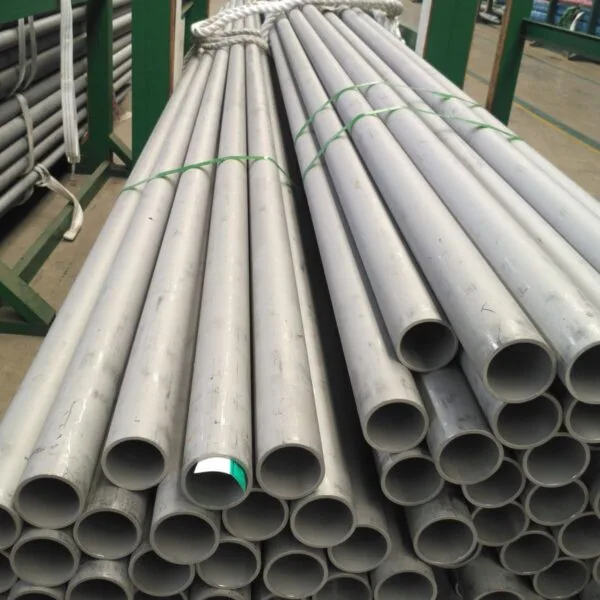
What Is a Seamless Stainless Steel TP314 Tube?
TP314 (UNS S31400) is the high-silicon 25/20 grade: silicon is specified at 1.50–3.00 %, roughly two to three times the 310-family ceiling, and that silicon is the grade. It modifies the oxide into a more silica-rich, slower-growing scale that stays adherent when the furnace cycles, and it holds up better in carburizing and nitriding atmospheres than plain 25/20.
S31400 is not a tabulated grade in ASTM A312, A213 or A269, so the order is written against an agreed chemistry, annealing condition and test schedule, with A213 as the dimensional reference. Give OD, wall basis, length, and the atmosphere and temperature profile the tube will see.
In one sentence: TP314 (UNS S31400) is a 25% Cr / 20% Ni austenitic tube with 1.5–3.0% silicon, giving it resistance to carburising and cyclic oxidising atmospheres up to roughly 1150 °C where 310S fails.
What the silicon addition in TP314 changes
TP314 keeps the 25/20 base of 310S but adds silicon. That silicon raises the activity of chromium at the surface and produces a more tenacious, slower-growing oxide, which is why 314 tolerates carburising and alternating oxidising/reducing atmospheres that destroy 310S scale. Typical service is radiant tubes, carburising-furnace fixtures, retorts, and recuperator tubes in petrochemical furnaces at 1000–1150 °C.
The same silicon makes the alloy harder to work. Hot ductility drops, so seamless tubes are produced in a narrow temperature window and welding needs a matching consumable and qualified procedure; the weld zone is normally the limiting feature in service. Because 314 is not a standard A213 grade, it is supplied against an agreed specification: chemistry, annealing condition and acceptance tests must be written into the order rather than assumed from a table.
- Best where the atmosphere alternates between oxidising and reducing, or carries carbon potential.
- Silicon raises high-temperature strength but lowers weldability — specify the welding consumable.
- Supplied to an agreed specification; agree chemistry limits and heat treatment before booking.
Compare with TP310S tube for clean oxidising duty, TP309S tube for 980 °C furnace internals.
Key Features and Advantages
What 2 % silicon buys in a furnace tube — and what it costs:
Silicon at 1.50–3.00 % Is the Grade
The silica-bearing scale grows more slowly and spalls less under thermal cycling than the scale on 310/310S — the reason 314 is specified for radiant tubes that heat and cool with the furnace.
Carburizing and Nitriding Atmospheres
High carbon or nitrogen potential in the process gas degrades plain austenitics quickly; the 314 scale acts as a slower diffusion barrier, extending fixture and pot life in atmosphere furnaces.
Radiant-Tube Service Record
Gas-fired radiant tubes, retorts, muffles and fan shafts in heat-treat lines are the classic application — parts whose life is limited by cyclic oxidation rather than mechanical stress.
Trade-Offs to Plan For
Silicon raises hot-cracking sensitivity in welding and speeds sigma formation after long exposure at 650–900 °C. 314 is not the first choice for high-stress load-bearing parts, and weld procedures and joint restraints need attention.
Agreed-Specification Ordering
Because no ASTM tube standard tabulates S31400, the chemistry including the silicon range, the condition and the test scope are written into the purchase order and verified heat by heat on the MTC.
314 Tube Specifications and Data
The reference data an agreed S31400 order hangs on: chemistry with silicon held at 1.50–3.00 %, mechanical minimums, physical constants and the A1016 tolerance basis.
Equivalent Grade
| UNS | Common grade name | EN material number | EN steel name | JIS grade | GB/T grade |
|---|---|---|---|---|---|
| S31400 | 314 | 1.4841 | Not confirmed | Not confirmed | Not confirmed |
Grade correspondence does not make ASTM, ASME, EN, JIS and GB delivery requirements interchangeable. Confirm chemistry, heat treatment, mechanical properties, dimensions, testing and certification against the purchase specification. Approximate or unconfirmed correspondences retain their qualification. See the grade designation index.
Chemical Composition
The composition of Stainless Steel 314 is carefully balanced to achieve its superior high-temperature oxidation resistance and strength.
| C | Mn | P | S | Si | Cr | Ni |
|---|---|---|---|---|---|---|
| ≤0.25 | ≤2.00 | ≤0.045 | ≤0.030 | 1.50-3.00 | 23.00-26.00 | 19.00-22.00 |
Data source: Heat-analysis acceptance limits shown above are the values commonly specified for TP314 (S31400) high-silicon austenitic steel. Because TP314 is not listed in ASTM A312/A213/A269, the governing specification and edition are those agreed on the purchase order; always confirm the limits against that ordered edition and the mill test certificate (MTC).
Stainless Steel 314 is specifically designed to maintain its strength and shape in high-stress, high-temperature environments.
| Tensile Strength | Yield Strength | Elongation | Hardness |
|---|---|---|---|
| ≥ 520 MPa | ≥ 205 MPa | ≥ 40% | ≤ 217 HBW |
Typical Physical Properties
Physical constants for the high-silicon 25/20 analysis — note the lower melting range versus plain 310:
| Density | Melting Point | Thermal Expansion | Thermal Conductivity | Modulus of Elasticity | Electrical Resistivity |
|---|---|---|---|---|---|
| 7.9 g/cm³ | 1390 – 1420 °C approx. | 16.5 μm/m·°C (20-100°C) | 14.2 W/m·K (20°C) | 200 GPa | 0.78 × 10⁻⁶ Ω·m (20°C) |
Note: Typical values for reference only — not acceptance limits. Physical and mechanical properties are reported on the MTC against the ordered standard, product form and condition.
Silicon lowers the melting range and stiffens the scale; the second effect is the engineering reason for this grade, the first is why casting and welding parameters need more care than on 310S.
ASTM A1016/A1016M Tube Size Tolerance Chart
Size Tolerance (ASTM A1016/A1016M-24a, Tables 1–2 — applies when the order references A1016/ASME SA1016)
Permitted variations in outside diameter (A1016-24a Table 2):
| Manufacturing condition | Specified OD, in. [mm] | Over, in. [mm] | Under, in. [mm] |
|---|---|---|---|
| Hot-finished seamless | 4 [100] and under | 1/64 [0.4] | 1/32 [0.8] |
| Over 4 to 7-1/2 [100–200], incl | 1/64 [0.4] | 3/64 [1.2] | |
| Over 7-1/2 to 9 [200–225], incl | 1/64 [0.4] | 1/16 [1.6] | |
| Welded and cold-finished seamless | Under 1 [25] | 0.004 [0.1] | 0.004 [0.11] |
| 1 to 1-1/2 [25–40], incl | 0.006 [0.15] | 0.006 [0.15] | |
| Over 1-1/2 to 2 [40–50], excl | 0.008 [0.2] | 0.008 [0.2] | |
| 2 to 2-1/2 [50–65], excl | 0.010 [0.25] | 0.010 [0.25] | |
| 2-1/2 to 3 [65–75], excl | 0.012 [0.3] | 0.012 [0.3] | |
| 3 to 4 [75–100], incl | 0.015 [0.38] | 0.015 [0.38] | |
| Over 4 to 7-1/2 [100–200], incl | 0.015 [0.38] | 0.025 [0.64] | |
| Over 7-1/2 to 9 [200–225], incl | 0.015 [0.38] | 0.045 [1.14] |
Table values follow ASTM A1016/A1016M-24a, Tables 1–2, reproduced as published, including the 0.004 in. [0.11 mm] under-tolerance entry for sizes under 1 in. [25 mm]. Welded-only rows are omitted; the combined “welded and cold-finished seamless” rows apply to this product. Multiply inch values by 25.4 for millimetres.
Permitted variations in wall thickness (A1016-24a Table 1, % of specified wall):
| Manufacturing condition | Specified OD, in. [mm] | Wall ≤ 0.095 [2.4] | Over 0.095 to 0.150 [2.4–3.8], incl | Over 0.150 to 0.180 [3.8–4.6], incl | Over 0.180 [4.6] |
|---|---|---|---|---|---|
| Seamless, hot-finished | 4 [100] and under | +40 / 0 | +35 / 0 | +33 / 0 | +28 / 0 |
| Over 4 [100] | — | +35 / 0 | +33 / 0 | +28 / 0 | |
| Seamless, cold-finished | 1-1/2 [38.1] and under | +20 / 0 | |||
| Over 1-1/2 [38.1] | +22 / 0 | ||||
Tolerance basis: values quoted from ASTM A1016/A1016M-24a Tables 1–2 (§8–9). They apply to tubes as rolled or cold-finished, before swaging, expanding, bending, polishing or other fabricating operations. Additional rules of that standard apply in parallel: a mean-wall check of ±10 % for seamless tubes with OD ≥ 2 in. [50 mm] and wall ≥ 0.220 in. [5.6 mm] (§8.2), an ovality allowance for cold-finished seamless tubes under 2 in. OD after final heat treatment (§9.3), and agreement-based measurement when wall ≤ 2 % of OD (§9.4). For A269/A269M orders, dimensional tolerances follow the ordered A269 edition. Confirm the applicable table and edition on the quotation and MTC.
Length Tolerance
- For specific cut lengths, ASTM A1016/A1016M Table 3 gives the permissible variation by manufacturing condition and outside diameter: +3 mm / 0 mm for cold-worked seamless tube with OD below 50.8 mm, and +5 mm / 0 mm for cold-worked tube with OD from 50.8 mm and for hot-worked tube, subject to the footnotes of that table.
- A269 orders follow the dimensional requirements of the ordered edition and are not quoted from the A1016 table. State the length, the end preparation and any straightness limit in the RFQ.
Important Note: The values presented here are based on the dimensional tolerance tables in ASTM A1016/A1016M (General Requirements for Ferritic Alloy Steel, Austenitic Alloy Steel, and Stainless Steel Tubes), contains other essential requirements like straightness and details for tubes with ODs outside of this range. Where the ordered product specification states a different tolerance or wall basis, that requirement governs. Where the ordered product specification states a different tolerance or wall basis, that requirement governs. Always consult the latest official standard for design and procurement.
TP314 Tube Applications and Service Assessment
Where the high-silicon 25/20 analysis outperforms plain 310-family tube:
Heat-Treating Furnaces
- Radiant tubes for gas-fired furnaces
- Retorts, muffles and fan shafts
- Rollers and fixtures that cycle with the furnace
Carburizing and Nitriding Lines
- Fixtures and pots in high carbon-potential atmospheres
- Retorts on nitriding service
Chemical and Petrochemical Processing
- High-temperature oxidizing process equipment
- Furnace parts where 310S scaling life is marginal
Cement and Lime Kilns
- Burner hardware in the hot zone
- Kiln components seeing cyclic peak temperatures
Frequently asked questions
What role does silicon play when evaluating TP314 tubes for cyclic furnace service?
Silicon changes the oxide-scale behavior that is important in repeated furnace heating and cooling. For TP314 tubes, verify the specified composition and obtain atmosphere-specific oxidation evidence, then check mechanical life independently. A favorable cyclic-oxidation comparison does not prove that the tube has adequate creep strength or that a pressure design can use another grade’s allowables.
How should a TP314 tube order define chemistry and acceptance tests when the cited ASTM standard does not tabulate S31400?
List the complete S31400 composition, annealing condition, mechanical requirements, dimensional basis and tests in the contract. Identify which referenced tube-standard methods are adopted and which grade-specific requirements are agreed separately. The reviewed A213-25 does not provide an S31400 acceptance row, so its reference must not be presented as automatic certification of TP314 tubes.
Which atmosphere and temperature-profile data are needed to compare TP314 tubes with TP310S or 253 MA?
Provide gas composition, oxygen potential, sulfur and carbon-bearing species, local metal temperatures, dwell times and cycle severity. Compare oxidation loss and scale adherence as well as creep behavior for the exact tube conditions. A ranking based only on the highest quoted air temperature can miss the condition that actually controls a TP314, TP310S or 253 MA tube.
How should bendability, post-forming condition and weld procedures be qualified for TP314 tube assemblies?
Qualify the forming and welding sequence using the actual TP314 composition, wall and final condition. Specify bend geometry, permitted wall thinning and ovality, then agree any necessary post-forming heat treatment. The weld procedure and filler should address the intended atmosphere and thermal cycles; nominal family similarity to 310 does not establish fabrication interchangeability.
What creep and oxidation evidence is needed to establish a replacement interval for TP314 furnace tubes?
A replacement interval needs operating history, measured wall loss, temperature exposure, deformation and cracking observations, supported by the relevant oxidation and creep data. The inspection plan should focus on hot spots, supports and welds. No fixed life follows from the TP314 designation; refine the interval using actual condition monitoring and the equipment’s approved life-assessment method.
Technical review: page data reviewed by the Xinzhe technical desk on 2026-09-27. Chemistry acceptance limits follow the specification and edition agreed on the purchase order (TP314/S31400 is not listed in ASTM A312/A213/A269); the specified tensile, yield and elongation minima are acceptance requirements of the stated edition, size range, orientation and delivery condition, while density, thermal conductivity, modulus and similar physical data are typical reference values carrying their own temperature and source basis. Values must be confirmed against the standard edition in force at order time and the material test certificate.
Ready to Request a Quotation?
Tell us the atmosphere (air, endothermic, carburizing, nitriding), the peak and cyclic temperature profile, OD × wall with the wall basis, length and end finish, and the silicon-range verification you want on the MTC. The quotation states the agreed specification and edition, delivery condition, documents included and lead time.
For the same grade in pipe form, see the TP314 seamless pipe page Stainless Steel Seamless Tube category.