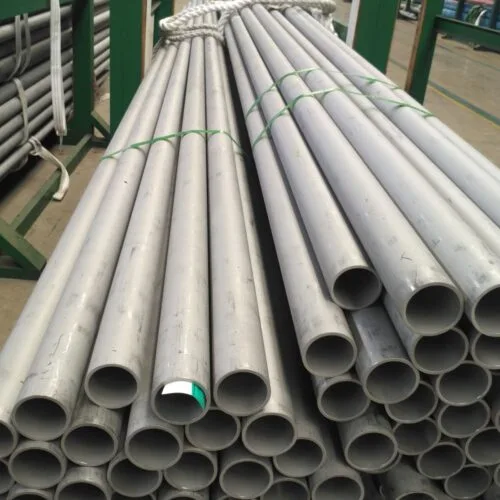
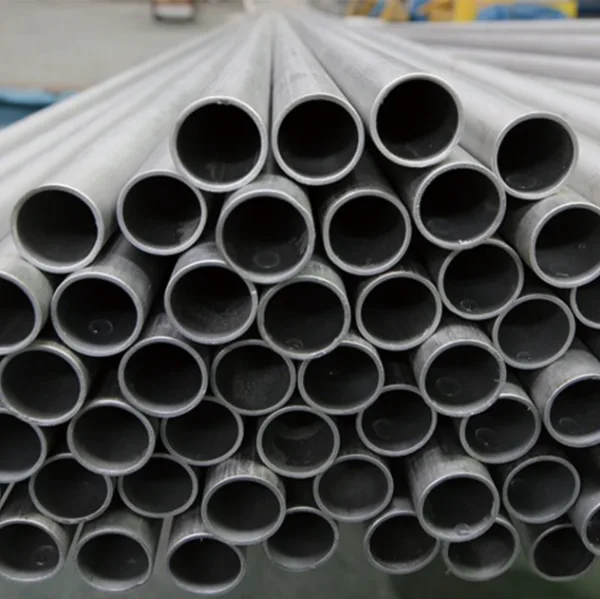
What Is a Seamless Stainless Steel TP310 Tube?
TP310 (UNS S31000) seamless tube is the 25 % chromium / 20 % nickel austenitic grade supplied against an agreed specification, because A213/A213M-25 Table 2 tabulates the low-carbon (TP310S) and controlled-carbon (TP310H) variants but carries no S31000 row. In practice an order written as “310” resolves to one of two carbon levels: the ≤ 0.08 % ceiling shown above, which suits welded construction, or the higher-carbon A312 TP310 variant where creep loading governs.
State on the purchase order which carbon ceiling, annealing condition and test scope you need; the size range (OD 6–257 mm, WT 0.5–35 mm) is the family capability, and the specific OD × wall × length combination for the ordered heat is confirmed in the quotation.
In one sentence: TP310 (UNS S31000) is the original 25% Cr / 20% Ni austenitic tube without a low-carbon limit, still used for high-temperature parts where weldability and post-weld corrosion are not the governing requirements.
Where plain TP310 is still the right call
TP310 permits up to 0.25% carbon. That gives useful high-temperature strength and scale resistance, but it also means chromium carbides form readily at grain boundaries during welding or slow cooling through 500–850 °C. In a welded assembly the heat-affected zone can therefore be sensitised, and intergranular corrosion becomes the limiting life factor in any wet or condensing service downstream.
In practice TP310 is specified for unwelded or lightly welded high-temperature parts — furnace rollers, support grids, radiant-tube hangers, heat-treatment fixtures — where the metal stays dry and hot. It is not a substitute for 310S in a welded pressure boundary, and it is not supplied against a standard A213 chemistry table without agreement. Orders are written to an agreed specification that fixes carbon, annealing condition and acceptance testing.
- Avoid for welded pressure parts and for any condensing or aqueous service.
- Well suited to dry, static furnace hardware at 900–1050 °C.
- Supplied to an agreed specification: state carbon range and heat treatment on the enquiry.
Compare with TP310S tube for welded assemblies, TP310H tube for creep-limited duty.
Key Features and Advantages of TP310 Seamless Stainless Steel Tube
What the 25/20 chemistry buys in a general furnace-duty tube, and what to watch on the order:
25/20 Chromium–Nickel Balance
A 24–26 % Cr / 19–22 % Ni analysis forms the slow-growing chromite scale that keeps this family serviceable in air and flue gas to about 1050 °C — the reason 25/20 tube is a default furnace choice at all.
Carbon Ceiling Agreed on the Order
Because S31000 has no A213 row, the carbon max is a purchase-order decision: ≤ 0.08 % for welded assemblies, or the higher-carbon variant where sustained load above 600 °C points to the TP310H tube page instead.
Furnace-Part Fabricability
The tube bends, flares and welds with standard shop practice for muffles, radiant-tube runs, quench racks and burner piping — formed parts are solution annealed when the drawing calls for it.
Heat-by-Heat Agreed Testing
Each heat is tested against the criteria written into the order: chemistry including carbon, mechanicals, hydrostatic or NDT, and EN 10204 3.1 certification as standard.
Sigma-Phase Watch on Slow-Cycled Parts
Long exposure between 650 °C and 900 °C can precipitate sigma in 25/20 grades and cost ductility — state the time-at-temperature profile for parts that dwell in that band.
310 Tube Specifications and Data
The reference data an agreed S31000 order is written around: chemistry with the carbon ceiling, mechanical minimums, physical constants and the A1016 dimensional basis used for tube tolerances.
Equivalent Grade
| UNS | Common grade name | EN material number | EN steel name | JIS grade | GB/T grade |
|---|---|---|---|---|---|
| S31000 | TP310 | Not confirmed | Not confirmed | Not confirmed | Not confirmed |
Chemical Composition
The composition of Stainless Steel 310 is carefully balanced to achieve its superior high-temperature oxidation resistance and strength.| C | Si | Mn | P | S | Cr | Ni | Fe |
|---|---|---|---|---|---|---|---|
| ≤0.08 | ≤1.00 | ≤2.00 | ≤0.045 | ≤0.030 | 24.00–26.00 | 19.00–22.00 | Bal |
| Tensile Strength | Yield Strength | Elongation | Hardness |
|---|---|---|---|
| ≥ 515 MPa | ≥ 205 MPa | ≥ 35% | ≤ 192 HBW / 200 HV / 90 HRB |
Typical Physical Properties
Physical constants for the 25/20 family; within an agreed carbon ceiling these values move very little from heat to heat.
| Density | Melting Point | Thermal Expansion | Thermal Conductivity | Modulus of Elasticity | Electrical Resistivity |
|---|---|---|---|---|---|
| 7.9 g/cm³ | 1400 – 1450 °C approx | 16.5 μm/m·°C (20-100°C) | 14.2 W/m·K (20°C) | 200 GPa | 0.78 × 10⁻⁶ Ω·m (20°C) |
Note: Typical values for reference only — not acceptance limits. Physical and mechanical properties are reported on the MTC against the ordered standard, product form and condition.
Carbon within the agreed ceiling shifts these constants negligibly; what carbon does move is weldability and long-term creep strength, which is why the carbon level — not the physical data — is the decision that shapes an S31000 tube order.
ASTM A1016/A1016M Tube Size Tolerance Chart
Size Tolerance (ASTM A1016/A1016M-24a, Tables 1–2 — applies when the order references A1016/ASME SA1016)
Permitted variations in outside diameter (A1016-24a Table 2):
| Manufacturing condition | Specified OD, in. [mm] | Over, in. [mm] | Under, in. [mm] |
|---|---|---|---|
| Hot-finished seamless | 4 [100] and under | 1/64 [0.4] | 1/32 [0.8] |
| Over 4 to 7-1/2 [100–200], incl | 1/64 [0.4] | 3/64 [1.2] | |
| Over 7-1/2 to 9 [200–225], incl | 1/64 [0.4] | 1/16 [1.6] | |
| Welded and cold-finished seamless | Under 1 [25] | 0.004 [0.1] | 0.004 [0.11] |
| 1 to 1-1/2 [25–40], incl | 0.006 [0.15] | 0.006 [0.15] | |
| Over 1-1/2 to 2 [40–50], excl | 0.008 [0.2] | 0.008 [0.2] | |
| 2 to 2-1/2 [50–65], excl | 0.010 [0.25] | 0.010 [0.25] | |
| 2-1/2 to 3 [65–75], excl | 0.012 [0.3] | 0.012 [0.3] | |
| 3 to 4 [75–100], incl | 0.015 [0.38] | 0.015 [0.38] | |
| Over 4 to 7-1/2 [100–200], incl | 0.015 [0.38] | 0.025 [0.64] | |
| Over 7-1/2 to 9 [200–225], incl | 0.015 [0.38] | 0.045 [1.14] |
Table values follow ASTM A1016/A1016M-24a, Tables 1–2, reproduced as published, including the 0.004 in. [0.11 mm] under-tolerance entry for sizes under 1 in. [25 mm]. Welded-only rows are omitted; the combined “welded and cold-finished seamless” rows apply to this product. Multiply inch values by 25.4 for millimetres.
Permitted variations in wall thickness (A1016-24a Table 1, % of specified wall):
| Manufacturing condition | Specified OD, in. [mm] | Wall ≤ 0.095 [2.4] | Over 0.095 to 0.150 [2.4–3.8], incl | Over 0.150 to 0.180 [3.8–4.6], incl | Over 0.180 [4.6] |
|---|---|---|---|---|---|
| Seamless, hot-finished | 4 [100] and under | +40 / 0 | +35 / 0 | +33 / 0 | +28 / 0 |
| Over 4 [100] | — | +35 / 0 | +33 / 0 | +28 / 0 | |
| Seamless, cold-finished | 1-1/2 [38.1] and under | +20 / 0 | |||
| Over 1-1/2 [38.1] | +22 / 0 | ||||
TP310 (UNS S31000) seamless tube is quoted against the tubing duty agreed with the mill: S31000 is not an A213 Table 2 grade, so the order states chemistry, annealing condition and acceptance tests, with A213 used for dimensions and test methods. The 25 % Cr / 20 % Ni chemistry is chosen for oxidising service above 1000 °C. Give OD, wall basis, length, form and the tests required.
Length Tolerance
- For specific cut lengths, ASTM A1016/A1016M Table 3 gives the permissible variation by manufacturing condition and outside diameter: +3 mm / 0 mm for cold-worked seamless tube with OD below 50.8 mm, and +5 mm / 0 mm for cold-worked tube with OD from 50.8 mm and for hot-worked tube, subject to the footnotes of that table. A269 orders follow the dimensional requirements of the ordered edition and are not quoted from the A1016 table; state the length, end preparation and any straightness limit in the RFQ.
Common Applications of Seamless Stainless Steel TP310 Tube
The combination of high-temperature strength and exceptional oxidation resistance of Seamless TP310 Tube makes them a preferred choice for:TP310 Tube Applications and Service Assessment
Where an agreed-specification 25/20 tube earns its place in high-temperature equipment:
Heat-Treating Furnaces
- Radiant tubes and muffles for annealing and tempering lines
- Retorts, baskets and trays for batch furnaces
- Conveyor rails and guide tubes in continuous furnaces
Power Generation
- Boiler accessories and reheater-support tubing
- Steam-generator internals in moderate-creep duty
- Flue-gas dampers and instrumentation thimbles
Chemical and Petrochemical Processing
- Furnace tubes and burner components in hot hydrocarbon service
- Transfer lines carrying hot process gas
- Reactor internals away from high-stress bolting
Cement and Lime Kilns
- Burner pipes and kiln-nose hardware
- Clinker-cooler tubing in abrasive hot service
Incineration and Environmental Equipment
- Waste-heat boiler tubing in hot flue gas
- Quench and scrubber internals downstream of the furnace
Frequently asked questions
How should a plain 310 tube enquiry distinguish S31000 from the 310S and 310H variants?
Define whether the requirement is truly S31000 or an intended 310S/310H tube. State the carbon requirement, ordered specification and final condition rather than relying on the drawing label 310. This is particularly important for replacement bundles, where matching OD and alloy family can conceal a change in the original creep or fabrication requirements.
What agreed chemistry, heat treatment and tests are needed when S31000 is outside the ordered tube standard’s grade table?
Agree chemistry, manufacturing condition, heat treatment, tensile requirements, any creep or grain-size provisions, dimensions and examinations in a separate purchase specification. Referenced A213 methods or tolerances can be adopted by agreement, but should not be presented as an A213-25 S31000 grade row. Pressure equipment also needs approval of the material route under its design rules.
Which creep-design data are needed before using plain 310 tubes in a pressure-retaining furnace coil?
The design needs approved allowable stresses or another accepted material basis at the actual tube-metal temperature, together with the required life and creep or rupture assessment. Room-temperature tensile results and an air-oxidation limit are insufficient. A specially ordered 310 tube should not enter a pressure-retaining furnace coil merely because a similar 310H product is code-listed.
How should thermal expansion, tube supports and temperature gradients be assessed for 310 tube assemblies?
Calculate expansion from the tube temperature distribution and restraint arrangement, then check supports, bends and connections for the resulting movement and loads. Consider creep sag under sustained temperature and repeated startup cycles. Support spacing and clearances should come from the assembly design, not a generic room-temperature straightness tolerance or the alloy’s nominal strength.
What dimensional and metallurgical acceptance records should be specified for custom S31000 tubes?
Specify chemistry, delivered heat treatment, measured tensile results, dimensional inspection and the agreed integrity tests. Add metallography, grain size or corrosion testing only where the special material specification requires them. For custom S31000 tubes, acceptance records must demonstrate the agreed product rather than borrowing 310S or 310H certificate limits without authorization.
Technical review: page data reviewed by the Xinzhe technical desk on 2026-09-27. Chemistry acceptance limits are compiled from the governing ASTM/ASME specification stated on this page; the specified tensile, yield and elongation minima are acceptance requirements of the stated edition, size range, orientation and delivery condition, while density, thermal conductivity, modulus and similar physical data are typical reference values carrying their own temperature and source basis. Values must be confirmed against the standard edition in force at order time and the material test certificate.
Ready to Request a Quotation?
For an agreed-specification 310 order, send the carbon ceiling you need, the specification and edition (or ask us to propose the agreed-chemistry wording), OD × wall with the wall basis, length, end finish and the inspection items you want as acceptance criteria. The quotation states the agreed specification, delivery condition, documents included and lead time.
For the same grade in pipe form, see the TP310 seamless pipe page Stainless Steel Seamless Pipe category.