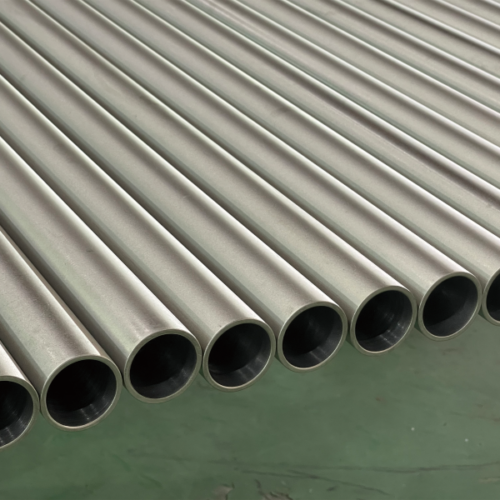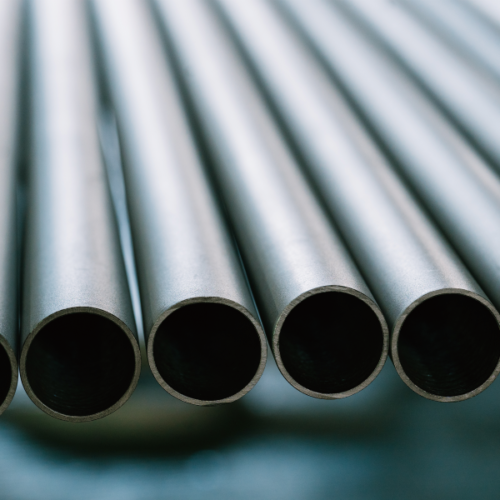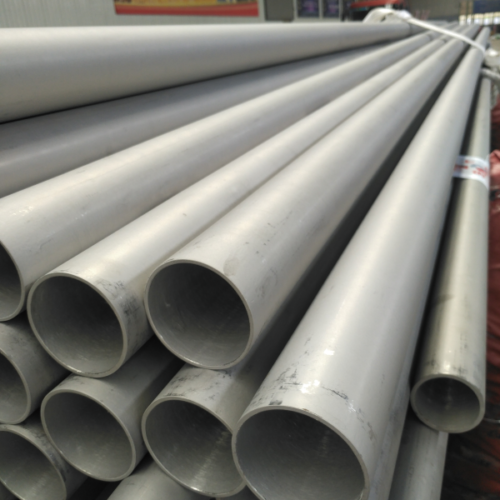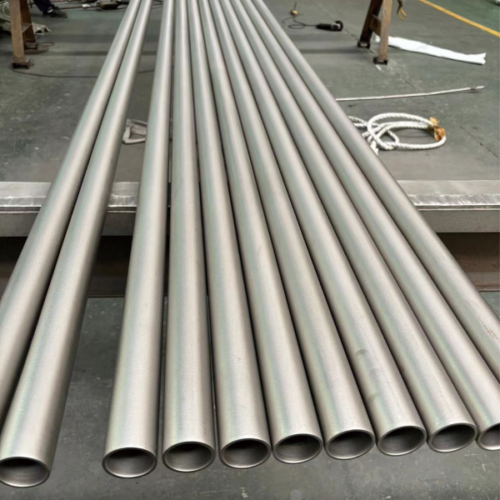

Seamless Hastelloy C22 pipe (UNS N06022 / W.Nr. 2.4602), to ASTM B622 / ASME SB622, ordered by nominal pipe size and schedule.
Seamless Hastelloy C22 pipe (UNS N06022 / W.Nr. 2.4602) is the pipe form of the nickel–chromium–molybdenum–tungsten alloy that resists both oxidising and reducing media. In pipe form it is ordered the way process piping is bought: by nominal pipe size and schedule — for example NPS 2 in. SCH 40 — to ASTM B622 / ASME SB622, with the end preparation, inspection scope and documents agreed on the order.
This page is written for that buying decision: what the standard requires, what our quotation covers, what we can normally supply, and what has to be asked for separately.
What Hastelloy C22 (UNS N06022) is
HASTELLOY® C-22® alloy is a nickel–chromium–molybdenum–tungsten alloy, designated UNS N06022 / W.Nr. 2.4602 / NiCr21Mo14W. Its distinguishing feature is that it performs on both sides of the redox divide: the chromium content (20.0–22.5 %) maintains a passive film in oxidising media, while molybdenum (12.5–14.5 %) and tungsten (2.5–3.5 %) carry the reducing side. That combination is why it is chosen for mixed and contaminated process streams, and why it is the usual upgrade when a C276 line has suffered from an oxidising upset.
C-22 is a trademark of Haynes International. Composition limits quoted on this page are from ASTM B622; typical property values are from the Haynes International data sheet for the alloy.
How we supply C22 seamless pipe
We are a China-based stockist and supplier of seamless stainless steel, duplex, super duplex and nickel alloy pipe and tube, working from Wenzhou, Zhejiang. That role is worth stating plainly, because it decides what you can expect from a quotation: the heat is melted and the tube is made by the mill, the material test certificate is issued for that heat, and our job is to make sure the grade, dimensions, condition, inspection scope and documents you receive are the ones you specified. Common sizes are quoted from stock of the sizes we normally hold; everything else is sourced mill-direct from qualified producers. Availability and price move with mill schedules and stock, so both are confirmed in the quotation rather than published as a fixed list.
C22 or C276 — how the choice is actually made
The two alloys are not ranked against each other, they cover different media. The usual starting point:
- Oxidising or mixed duty → C22. Nitric acid, ferric chloride, cupric chloride, wet chlorine, chlorine dioxide, hypochlorite, and process streams that swing between oxidising and reducing. The higher chromium content is what buys this.
- Strongly reducing duty → C276. Pure hydrochloric acid and similar strongly reducing streams, where the higher molybdenum (15.0–17.0 % against 12.5–14.5 %) and tungsten (3.0–4.5 % against 2.5–3.5 %) content matters more.
Past that, the decision depends on the medium, its concentration, the operating temperature, whether oxidisers or chlorides are present, and which form of attack you are designing against — general thinning, pitting, crevice attack or stress corrosion cracking. A statement that one grade is simply “better” is not usable for selection. Send us the medium, concentration and temperature, and we will quote the suitable grades side by side.
Corrosion performance, with the test conditions attached
The figures below are laboratory screening results, and they are only meaningful with their conditions. They are useful for comparing alloys; they are not a service life.
| Test and conditions | Hastelloy C22 | Hastelloy C276 | What it shows |
|---|---|---|---|
| ASTM G48, acidified 6 wt % FeCl₃, 72 h — critical pitting temperature | > 150 °C | > 150 °C | Both alloys resisted pitting up to the upper limit of the test. |
| ASTM G48, same solution — critical crevice temperature | 80 °C | 55 °C | C22 withstood a higher temperature before crevice attack in this solution. |
| ASTM G36, boiling 45 % MgCl₂, stressed U-bend, test stopped at 1 008 h | No cracking in 1 008 h | No cracking in 1 008 h | Both resisted chloride-induced stress corrosion cracking. For scale: 316L cracked in 2 h, 254 SMO in 24 h. |
| Green Death (11.5 % H₂SO₄ + 1.2 % HCl + 1 % FeCl₃ + 1 % CuCl₂), 24 h — lowest temperature at which pitting was observed | 120 °C | boiling | In this oxidising acid mixture C22 pitted at a markedly higher temperature, which is the difference the extra chromium buys. |
| Yellow Death (4 % NaCl + 0.1 % Fe₂(SO₄)₃ + 0.021 M HCl), 24 h | No pitting up to 150 °C; critical crevice temperature 75 °C | Critical crevice temperature 60 °C | C22 tolerated a higher crevice temperature in this chloride solution. |
Test data: Haynes International corrosion data for HASTELLOY C-22 and C-276 alloys. Values were obtained in fixed laboratory solutions for fixed durations. Use them to compare alloys — not to derive a service temperature, a corrosion allowance or a service life for a specific plant medium. Where the decision matters, run corrosion tests on the actual medium or work from documented plant experience.
Seamless construction — what it does and does not guarantee
Seamless pipe is made from a solid billet by hot working and then cold finishing, so there is no longitudinal weld seam in the wall. That is a genuine difference from welded pipe, and for some duties it is the reason seamless is specified. It is not by itself a pressure rating, and it is not a blanket guarantee of a more uniform structure.
- Pressure capability is a function of the specified outside diameter, the wall thickness and its tolerance, the delivered condition, the design temperature, the design code applied and the inspection performed. The word “seamless” does not set any of those numbers.
- Grain structure and cleanliness follow from the mill’s melting, working and annealing practice, not from the absence of a weld. Two seamless tubes from different mills will not necessarily be equivalent.
- If wall integrity matters, specify it. Ask for the non-destructive examination and the document you need — hydrostatic or eddy current testing per the standard, ultrasonic testing, PMI, or witnessed inspection — rather than relying on the manufacturing route to imply it.
Temperature — three different limits, not one
A single “maximum service temperature” figure is the kind of number that causes trouble, because it mixes up three separate things. Keep them apart when you specify:
- Melting range (a physical property): 1357–1399 °C for C-22. This is solidus to liquidus for the alloy and is not a service limit of any kind.
- Design-code limit: the maximum temperature at which the applicable construction code approves the alloy for the product form you are buying. It differs from code to code, as the table below shows — the same alloy is approved to 677 °C under one code and to 343 °C under another.
- Service temperature: set by corrosion. For aqueous process duty this is normally far below the code limit, because what limits the alloy is the corrosion rate in that medium at that concentration and temperature — not the alloy’s strength.
| Design code | Maximum temperature listed for C-22 | Product forms approved |
|---|---|---|
| ASME Section I | 677 °C (1250 °F) | incl. seamless pipe and tube |
| ASME Section III, Class 1 | 427 °C (800 °F) | incl. seamless pipe and tube |
| ASME Section III, Class 2 and 3 | 677 °C (1250 °F) | incl. seamless pipe and tube |
| ASME Section VIII, Div. 1 | 677 °C (1250 °F) | incl. seamless pipe and tube |
| ASME Section VIII, Div. 2 | 677 °C (1250 °F) | incl. seamless pipe and tube |
| ASME Section XII | 343 °C (650 °F) | incl. seamless pipe and tube |
| ASME B31.1 | 427 °C (800 °F) | incl. seamless pipe and tube |
| ASME B31.3 | 427 °C (800 °F) | incl. seamless pipe and tube |
| ASME B16.34 | 677 °C (1250 °F) | incl. seamless pipe and tube |
| VdTÜV Wbl. 479 | 450 °C (844 °F) | plate, sheet, bar, forgings |
Source: Haynes International data sheet, codes table. These are the temperatures at which the alloy is listed as an approved material for that code and product form — they depend on the code edition and the form, and they are not corrosion limits. The design temperature for your equipment must be taken from the code and from its allowable stress tables, together with the corrosion assessment for the medium.
Ordering tube instead? Seamless Hastelloy C22 tube is the same alloy ordered by outside diameter and wall thickness — the route for heat exchanger, condenser and instrument tubing. Also available in the same family: Hastelloy C276 seamless pipe, B2 seamless pipe and B3 seamless pipe.
Product specifications and data
The tables below are separated by what they actually are: ASTM B622 acceptance requirements, typical published properties of the alloy, and dimensional data. Each table states its basis in the table itself. Where a typical value and a standard requirement differ, the standard and your purchase order govern.
Size Range: OD 6–457 mm · WT 0.6–35 mm
Equivalent Grade
| UNS | Common grade name | EN material number | EN steel name | JIS grade | GB/T grade |
|---|---|---|---|---|---|
| N06022 | Hastelloy C-22 | 2.4602 | NiCr21Mo14W | NW6022 | NS3308 |
Grade correspondence does not make ASTM, ASME, EN, JIS and GB delivery requirements interchangeable. Confirm chemistry, heat treatment, mechanical properties, dimensions, testing and certification against the purchase specification. See the grade designation index.
Chemical Composition (ASTM B622)
Composition limits for UNS N06022 as required by ASTM B622 / ASME SB622, Table 1. These are acceptance limits verified on the heat analysis — not a description of the alloy and not the analysis of one particular heat.
| Ni | Cr | Mo | Fe | W | C | Mn | Si | Co | V | P | S |
|---|---|---|---|---|---|---|---|---|---|---|---|
| Bal | 20.00–22.50 | 12.50–14.50 | 2.00–6.00 | 2.50–3.50 | ≤0.015 | ≤0.50 | ≤0.080 | ≤2.50 | ≤0.35 | ≤0.02 | ≤0.02 |
Values are maximum unless a range is shown; nickel is the balance. Three different kinds of composition data circulate for this alloy and they must not be mixed: (1) standard limits — the table above, which is what your order is accepted against; (2) the alloy producer’s nominal composition — a rounded description such as 22 % Cr, 13 % Mo, 3 % W, 3 % Fe, Ni balance, used to explain why the alloy behaves as it does and not a specification; and (3) the actual heat analysis of the material delivered, which is stated on the MTC and may sit anywhere inside the limits. A nominal figure that differs from a limit is not evidence that either is wrong.
Mechanical Properties (ASTM B622)
These are the room-temperature acceptance requirements of ASTM B622, Table 2 for UNS N06022 in the solution-annealed condition. They are minimum requirements, not typical values.
| Tensile strength | Yield strength, 0.2 % offset | Elongation | Hardness | |
|---|---|---|---|---|
| Requirement | ≥ 690 MPa (100 ksi) | ≥ 310 MPa (45 ksi) | ≥ 45 % | Not an acceptance requirement of ASTM B622, Table 2 |
| Basis and how it is reported | Room temperature, tension test to ASTM E8/E8M, specimens taken per lot. The measured value for your heat is stated on the MTC. | Same sampling and test as above; reported on the MTC. | Measured over a 2 in. (50.8 mm) gauge length, or 4D for round specimens; reported on the MTC. | The alloy producer reports typical room-temperature hardness of about 93 HRB for sheet and 95 HRB for plate. If hardness is an acceptance criterion for your project, state it on the order — it is then tested and reported separately. |
ASTM B622 requires the material to be supplied in the solution-annealed and descaled condition (§1.2), which is the condition these requirements apply to. Real heats of this alloy normally test well above the minimums — a typical tensile result is around 760–800 MPa — but the figure that applies to the material you receive is the one on your MTC, and only compliance with the minimum is guaranteed. Note also that the published typical values in the alloy literature are quoted for sheet, plate and bar, not for tube, so they are not a prediction of the tube result.
Physical Properties (typical values)
Typical published properties for the alloy, each with the temperature it was measured at. ASTM B622 does not specify physical properties, so these are for engineering reference and are not certified per batch.
| Density | Melting range | Coefficient of thermal expansion, mean | Thermal conductivity | Dynamic modulus of elasticity | Electrical resistivity | Specific heat | Poisson’s ratio |
|---|---|---|---|---|---|---|---|
| 8.69 g/cm³ — at 20 °C (room temperature) | 1357–1399 °C (solidus to liquidus) | 12.4 µm/m·°C (over 24–100 °C) | 10.1 to 21.3 W/m·K — over 50–600 °C (see below) | 206 GPa — at 20 °C (room temperature) | 1.14 µΩ·m — at 20 °C (room temperature) | 414 J/kg·°C (at 50 °C) | 0.32 (at room temperature) |
Electrical resistivity, thermal conductivity and modulus vs temperature
Properties like these change with temperature, so a single figure is only valid at the temperature at which it was measured. The published series for C-22 is:
| Temperature | Electrical resistivity, µΩ·m | Thermal conductivity, W/m·K | Dynamic modulus, GPa |
|---|---|---|---|
| 20 °C (room temperature) | 1.14 | — | 206 |
| 50 °C | — | 10.1 | — |
| 100 °C | 1.23 | 11.1 | — |
| 200 °C | 1.24 | 13.4 | 197 |
| 300 °C | 1.25 | 15.5 | 191 |
| 400 °C | 1.26 | 17.5 | 185 |
| 500 °C | 1.27 | 19.5 | 179 |
| 600 °C | 1.28 | 21.3 | 174 |
Source: Haynes International data sheet. — means the source lists no value at that temperature: thermal conductivity is listed from 50 °C upwards, while resistivity and modulus include a room-temperature value. Interpolate between the listed points for design work, and check the source table before using a figure at a temperature between two points. Specific heat over the same range rises from 414 J/kg·°C at 50 °C to 514 J/kg·°C at 600 °C.
Size, Schedule & Tolerances
What ASTM B622 covers, and how pipe is ordered
- ASTM B622 covers seamless pipe and tube of nickel and nickel-cobalt alloys, including UNS N06022 (this page’s grade), and requires the product to be supplied solution annealed and descaled (§1.2).
- The specification is limited to tubes up to and including 3.5 in. (88.9 mm) outside diameter (§1.3). NPS 1/4 to NPS 3, quoted on this page, sits inside that limit.
- Pipe is ordered by nominal pipe size and schedule, so the outside diameter is fixed for a given NPS and the wall comes from the schedule. Tube is ordered by outside diameter, minimum or average wall thickness, and length. The schedule table in Appendix X2 is non-mandatory information; the dimensions themselves follow the ANSI/ASME B36.10M schedule system.
- Pipe and tube are not interchangeable on a purchase order. If you are not sure which you need, send the drawing or the service and we will indicate the ordering route.
Pipe schedules — Appendix X2, Table X2.1 (inches)
| Nominal pipe size, in. | Outside diameter, in. | SCH 10 wall, in. | SCH 40 wall, in. | SCH 80 wall, in. |
|---|---|---|---|---|
| 1/4 | 0.540 | 0.065 | 0.088 | Not listed |
| 3/8 | 0.675 | 0.065 | 0.091 | 0.126 |
| 1/2 | 0.840 | 0.083 | 0.109 | 0.147 |
| 3/4 | 1.050 | 0.083 | 0.113 | 0.154 |
| 1 | 1.315 | 0.109 | 0.133 | 0.179 |
| 1 1/4 | 1.660 | 0.109 | 0.140 | 0.191 |
| 1 1/2 | 1.900 | 0.109 | 0.145 | 0.200 |
| 2 | 2.375 | 0.109 | 0.154 | 0.218 |
| 2 1/2 | 2.875 | 0.120 | 0.203 | 0.276 |
| 3 | 3.500 | 0.120 | 0.216 | 0.300 |
Pipe schedules — Appendix X2, Table X2.1 (millimetres)
| Nominal pipe size, in. | Outside diameter, mm | SCH 10 wall, mm | SCH 40 wall, mm | SCH 80 wall, mm |
|---|---|---|---|---|
| 1/4 | 13.72 | 1.65 | 2.24 | Not listed |
| 3/8 | 17.14 | 1.65 | 2.31 | 3.20 |
| 1/2 | 21.34 | 2.11 | 2.77 | 3.73 |
| 3/4 | 26.67 | 2.11 | 2.87 | 3.91 |
| 1 | 33.40 | 2.77 | 3.38 | 4.55 |
| 1 1/4 | 42.16 | 2.77 | 3.56 | 4.85 |
| 1 1/2 | 48.26 | 2.77 | 3.68 | 5.08 |
| 2 | 60.32 | 2.77 | 3.91 | 5.54 |
| 2 1/2 | 73.02 | 3.05 | 5.16 | 7.04 |
| 3 | 88.90 | 3.05 | 5.49 | 7.62 |
Dimensional tolerances
ASTM B622 requires the material to conform to the applicable general requirements of ASTM B829 unless the order provides otherwise, so the permissible variation in outside diameter, wall thickness, length and straightness comes from that document. The tolerance that applies to your order is the one in the edition of the standard named on your purchase order, and it differs between cold-finished and hot-finished product and between outside diameter ranges. Duplex stainless tolerances such as ASTM A790/A999 have no application to this nickel alloy.
Where the tolerance is not stated, we confirm it in writing at quotation, referencing the standard and edition — do not design around a tolerance taken from a web page, including this one.
Standard reference vs. what we normally supply
| Item | Typical range / status | How it is confirmed |
|---|---|---|
| Nominal pipe size | NPS 1/4 in. to NPS 3 in. (13.72–88.90 mm OD) | Confirmed at quotation |
| Schedule / wall thickness | SCH 10, SCH 40, SCH 80 as listed in Appendix X2; other walls on request | Confirmed at quotation |
| Length | Random length, or cut to a specified length | Agreed on the purchase order |
| End finish | Plain ends as standard; bevelled ends on request | Agreed on the purchase order |
| Delivery condition | Solution annealed and descaled (pickled); bright annealed on request | Stated on the material test certificate |
| Documentation | EN 10204 3.1 MTC as standard; 3.2 or third-party witness on request | Requested at enquiry |
| Availability and price | Change with mill schedules and stock | Confirmed at quotation |
This table describes what we normally quote. It is not a stock list and it is not a commitment: the sizes actually available, and the date they can ship, are confirmed in the quotation. For the standard’s own dimensional tables, see the schedule tables above.
Applications of Hastelloy C22 pipe
C22 seamless pipe is normally specified where the medium is aggressive and the line is not easily replaced. Typical duties, in pipe rather than tube form:
- Chemical and petrochemical process lines — reactors, columns, acid handling, mixed-acid and chloride-bearing streams, and pipework subject to oxidising upsets.
- Flue gas desulfurisation and pollution control — scrubber circuits, recycle and spray headers, quench lines and ducting connections.
- Pharmaceutical and high-purity service — process pipework that has to survive cleaning chemicals and organic catalysts without contaminating the product.
- Pulp, paper and bleaching — chlorine dioxide and hypochlorite circuits, bleach plant piping.
- Seawater and brine handling — lines and headers where chloride attack and crevice corrosion govern the material choice.
Pipe ends, marking and length are part of the specification, not details to be left to the supplier: plain ends are our standard, bevelled ends are prepared on request, and both are stated on the purchase order along with the inspection scope.
Chemical Processing Industry
Used for reactors, heat exchangers, and acid-handling pipelines.
Flue Gas Desulfurization (FGD)
Ideal for scrubbers and flue gas systems exposed to corrosive gases.
Pharmaceutical Industry
Used in high-purity piping systems resistant to cleaning chemicals and organic catalysts.
Pulp and Paper Industry
Applied in chlorine dioxide processing equipment and bleaching plants.
Inspection and testing — what is standard and what is optional
Several tests listed on alloy pages are not part of the default supply. The matrix below separates what ASTM B622 requires on every order from what has to be asked for, because the difference changes price, lead time and sometimes the manufacturing route.
| Item | Basis | Frequency / extent | Status | Reported as |
|---|---|---|---|---|
| Chemical analysis | ASTM B622, Table 1 limits for UNS N06022 | Per heat / lot | Standard | EN 10204 3.1 MTC |
| Tension test, room temperature | ASTM B622, Table 2, tested to ASTM E8/E8M | Per lot, sample from the lot | Standard | 3.1 MTC |
| Hydrostatic test or non-destructive electric test | ASTM B622 (with ASTM B829) | Each pipe / each tube | Standard — one of the two, as agreed on the order | Test record on the MTC |
| Dimensional and visual examination | ASTM B622 with ASTM B829 tolerances | Each length | Standard | 3.1 MTC |
| Flare test | ASTM B829, §5.1, applied through ASTM B622, §4.1 | Per lot — specimen flared until the outside diameter is increased by 30 %; no cracking through the wall permitted | Standard | Test record |
| Hardness test | ASTM B829, §5.6, tested to ASTM E18 | Per lot where specified | Optional — ASTM B622, Table 2 sets no hardness requirement | Test report with the measured value |
| Positive material identification (PMI) | Not in ASTM B622 | Per piece or sampled — state which | Optional | PMI report |
| Intergranular corrosion test | ASTM G28 Method A, or as specified | Per lot | Optional | Test report |
| Pitting / crevice corrosion test | ASTM G48 Method A or B | Per lot | Optional | Test report |
| Grain size determination | ASTM E112 | Per lot | Optional | Test report |
| Third-party inspection or witnessing | The agency’s own scope | As agreed | Optional — carried out and reported by the agency, not by us | Agency report, and EN 10204 3.2 where required |
Which of these is in the price depends on the order. Tell us at the enquiry stage which items are acceptance criteria for your project: hardness, PMI, IGC, G48, grain size and witnessed inspection are not part of the default supply, and they cannot usually be added after the material has been produced.
Documents, traceability and delivery
- Material test certificate. EN 10204 3.1 as standard, issued for the heat actually supplied and stating grade, heat number, chemical analysis, tensile results, dimensions, condition and the tests performed.
- 3.2 certificate and witnessed inspection. On request. These are performed and signed by the third-party agency — nominated by you or proposed by us — and are not a certificate issued by our company.
- Traceability. Heat number is marked on each length and carried onto the MTC, so a piece can be traced back to its heat. Inspection records held by the mill for your order can be passed on where you need them.
- Marking and packing. Grade, size, standard and heat number stencilled or tagged; ends protected; packed for sea freight. Special marking, tagging or packing against your specification on request.
- Documents and photographs before you order. On request we can send a redacted MTC for a comparable order, dimensional inspection records, and photographs of the actual material being offered, so the paperwork can be checked before the order is placed.
Purchasing FAQ — Hastelloy C22 seamless pipe
What do you need from me to quote C22 pipe?
Size as nominal pipe size and schedule (or actual OD and wall if the line is dimensioned that way), quantity, length or cut-to-length tolerance, the standard and edition you want the pipe supplied to, end finish (plain or bevelled), the inspection items you need as acceptance criteria, the documentation required, and the delivery destination. If you have a purchase specification, send it — it is faster and less ambiguous than a description.
How is C22 pipe ordered, and how does that differ from tube?
Pipe is ordered by nominal pipe size and schedule, so for a given NPS the outside diameter is fixed and the wall comes from the schedule — NPS 2 in. SCH 40, for example. Tube is ordered by actual outside diameter and wall thickness, with the wall stated as minimum or average. The two are ordered on different dimension systems and are not interchangeable on a purchase order.
Which sizes and schedules do you normally supply?
Our usual quotation range is NPS 1/4 in. to NPS 3 in. in SCH 10, SCH 40 and SCH 80 — the range covered by the schedule table in Appendix X2 of ASTM B622, which also sits inside the specification’s OD limit of 88.9 mm. Walls outside these schedules can often be quoted. Stock and mill availability change, so the sizes actually available, and the shipping date, are confirmed in the quotation; see the supply table on this page.
Which tests are included in the quotation, and which cost extra?
Included as standard: chemical analysis, tension test and dimensional and visual examination to ASTM B622, plus the hydrostatic test or non-destructive electric test that the standard requires on each length — which of the two is agreed on the order. Asked for separately: PMI, ASTM G28 intergranular corrosion testing, ASTM G48 pitting and crevice testing, grain size, ultrasonic testing, EN 10204 3.2 certificates and third-party witnessed inspection. These affect price, lead time and sometimes the manufacturing route, so they have to be requested with the enquiry.
Can you supply a certificate traceable to the heat of the material I receive?
Yes. The EN 10204 3.1 MTC is issued for the heat actually supplied, and the heat number is marked on each length so a piece can be traced back to the certificate. If you asked for PMI, the report identifies the piece tested. A 3.2 certificate, where required, is signed by the third-party agency rather than issued by us.
Is the pipe supplied to ASTM B622 or ASME SB622, and which edition?
They are the same document issued by ASTM and adopted by ASME. If your design is to the ASME Boiler and Pressure Vessel Code, the correct reference is ASME SB622; for a commercial order, ASTM B622. The edition executed is confirmed on the purchase order — if your project specification was written against an earlier edition, say so and the quotation will be issued against that edition rather than the current one.
Should I compare C22 and C276 before deciding?
Send the medium, its concentration, the operating temperature and any corrosion data or existing inspection findings, and we will quote the suitable grades side by side. The short version: oxidising or mixed media normally point to C22 because of its higher chromium, while strongly reducing media such as pure hydrochloric acid normally point to C276 because of its higher molybdenum and tungsten. Neither is a general upgrade of the other.
What about pipe ends, marking and packing?
Plain ends are standard; bevelled ends are prepared on request. Each length is marked with grade, size, standard and heat number, ends are protected, and material is packed for sea freight. Special marking, tagging or packaging against your specification can be quoted on request — tell us the requirement with the enquiry so it is priced in rather than raised later.
The answers above describe our normal commercial practice. Every supply is confirmed individually in the quotation — nothing on this page should be read as a standing commitment to stock, tolerance, test scope or lead time.
Ready to Request a Quotation?
Send the NPS and schedule (or actual OD and wall), quantity, length, end finish and the inspection items you need as acceptance criteria — you will get a written quotation stating the specification and edition, delivery condition, documents included and lead time.