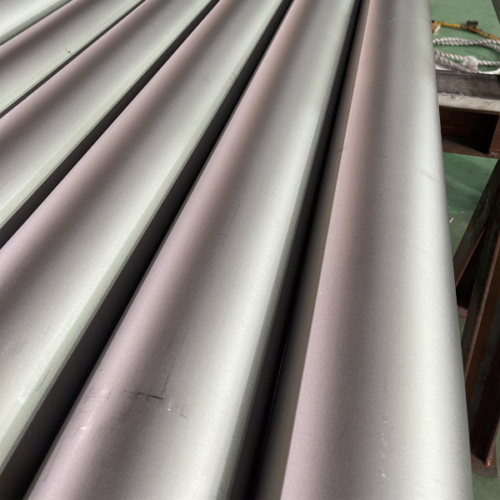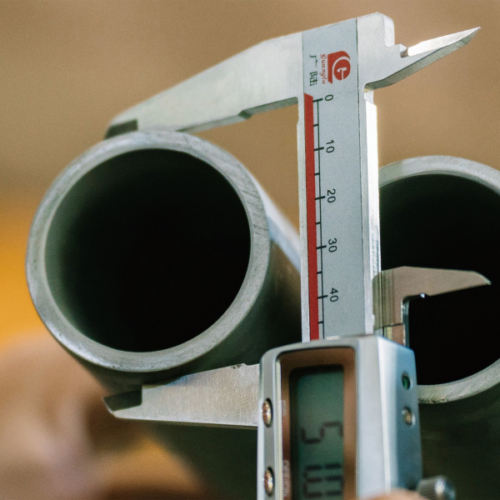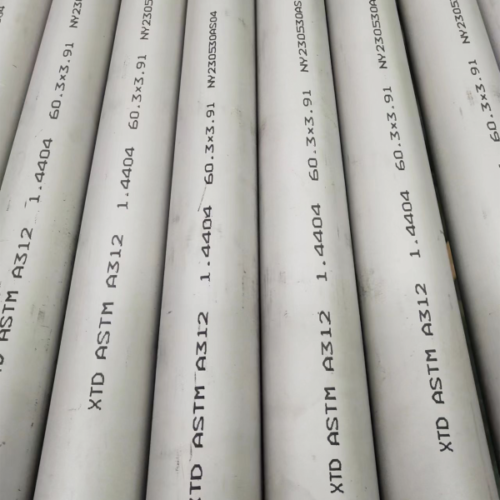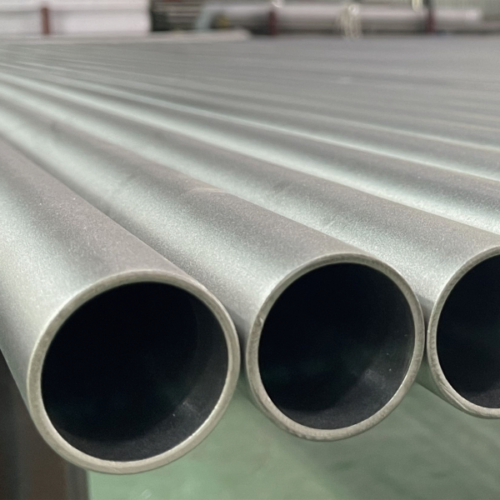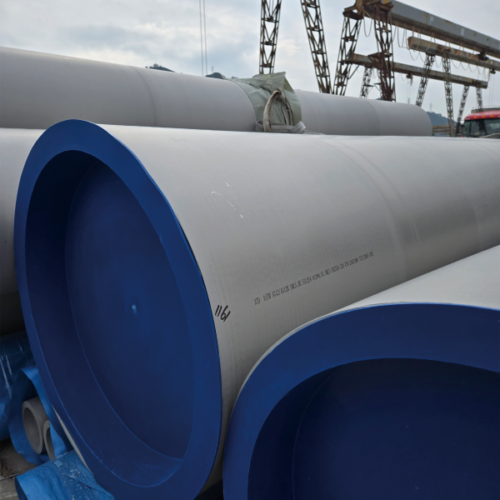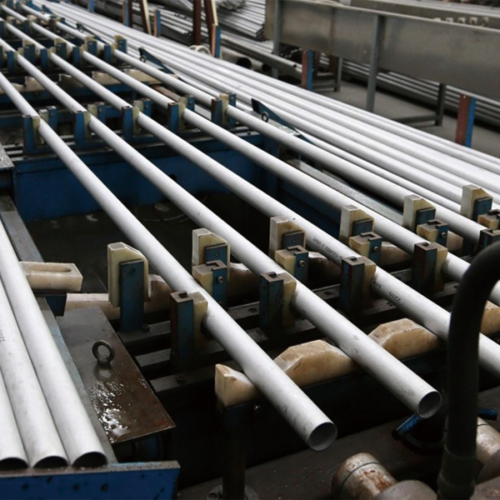

Seamless Stainless Steel TP321H Pipe (UNS S32109) – High-Temperature Structural Solution
TP321H Seamless Stainless Steel Pipe is supplied for titanium stabilization with higher carbon for high-temperature strength. The size range shown (OD 6–1016 mm; WT 0.5–65 mm) is the overall capability across this product family, not a per-grade commitment. Confirm the specific OD × WT × length combination for the ordered grade in the quotation. The governing specification must be stated on the purchase order: ASTM A312 / ASME SA312. Chemistry, mechanical properties, heat treatment, dimensional tolerance, NDT and certification must be reported against the ordered standard and material heat; do not treat typical values as guaranteed acceptance limits.
As the high-carbon version of Grade 321 stainless steel, the “H” designation indicates a controlled carbon range of 0.04% – 0.10%, which significantly improves creep rupture strength and high-temperature load-bearing capacity.
Manufactured using a seamless process, the pipe features a uniform grain structure without longitudinal weld seams, ensuring superior reliability under high pressure, thermal cycling, and mechanical stress.
Key Features and Technical Advantages
Enhanced Creep Rupture Strength
The increased carbon content improves resistance to creep deformation and rupture, making TP321H ideal for continuous high-temperature service in critical systems.
Titanium Stabilization (Anti-IGC Protection)
Titanium (Ti) binds with carbon to limit chromium carbide precipitation, greatly reducing the risk of intergranular corrosion (IGC) during welding and high-temperature exposure.
Excellent Oxidation and Scaling Resistance
TP321H offers stable performance in oxidizing environments up to 870°C (1600°F), ensuring long-term durability in harsh thermal conditions.
Seamless Structural Integrity
The absence of a longitudinal weld seam removes the weld joint from pressure design, so the pipe can be considered for service under high internal pressure and cyclic thermal stress.
Product Specifications and Data
To provide a comprehensive overview of this high-performance material, here are the detailed technical specifications and performance data for 321H stainless steel.
Equivalent Grade
| UNS | Common grade name | EN material number | EN steel name | JIS grade | GB/T grade |
|---|---|---|---|---|---|
| S32109 | 321H | 1.4940 (approx.) | X7CrNiTi18-10 | SUS 321H | 07Cr19Ni11Ti |
Grade correspondence does not make ASTM, ASME, EN, JIS and GB delivery requirements interchangeable. Confirm chemistry, heat treatment, mechanical properties, dimensions, testing and certification against the purchase specification. See the grade designation index.
Chemical Composition
The composition of Stainless Steel 321H is carefully balanced to achieve its superior high-temperature strength and corrosion resistance.
| Cr | Ni | P | S | Ti | Mn | Si | C |
|---|---|---|---|---|---|---|---|
| 17.00 – 19.00 | 9.00 – 12.00 | ≤ 0.045 | ≤ 0.030 | 4×(C+N)–0.70 | ≤ 2.00 | ≤ 1.00 | 0.04 – 0.10 |
Data source: ASTM A312-25 / ASME SA312 Table 1, TP321H row ≤ heat-analysis acceptance limits. Confirm the values against the ordered edition and the MTC.
Typical Mechanical Properties
Stainless Steel 321H is specifically designed to maintain its strength and shape in high-temperature, high-stress environments.
| Tensile Strength | Yield Strength | Elongation | Hardness |
|---|---|---|---|
| ≥ 515 MPa | ≥ 205 MPa | ≥ 35% | ≤ 192 HBW |
Note: Typical values for reference only — not acceptance limits. Mechanical properties are reported on the MTC against the ordered standard, product form, condition and test temperature.
Typical Physical Properties
These physical properties highlight the material’s ability to perform reliably under a wide range of conditions.
| Density | Melting Point | Thermal Expansion | Thermal Conductivity | Modulus of Elasticity | Electrical Resistivity |
|---|---|---|---|---|---|
| 8.0 g/cm3 | 1398 -1454 °C | 16.6 μm/m·°C (20-100°C) | 16.3 W/m·K (20°C) | 193 GPa | 0.72 × 10⁻⁶ Ω·m (20°C) |
Note: Typical values for reference only — not acceptance limits. Physical and mechanical properties are reported on the MTC against the ordered standard, product form and condition.
Size Tolerance Chart (mm)
| NPS Designator (Inches) | Permissible Variations in Outside Diameter (Inches) |
| 1⁄8 to 1 1⁄2, inclusive | Over: 1⁄64 in. (0.015 in.) |
| Under: 1⁄32 in. (0.031 in.) | |
| Over 1 1⁄2 to 4, inclusive | Over: 1⁄32 in. (0.031 in.) |
| Under: 1⁄32 in. (0.031 in.) | |
| Over 4 to 8, inclusive | Over: 1⁄16 in. (0.062 in.) |
| Under: 1⁄32 in. (0.031 in.) | |
| Over 8 to 18, inclusive | Over: 3⁄32 in. (0.093 in.) |
| Under: 1⁄32 in. (0.031 in.) | |
| Over 18 to 26, inclusive | Over: 1⁄8 in. (0.125 in.) |
| Under: 1⁄32 in. (0.031 in.) | |
| Over 26 to 34, inclusive | Over: 5⁄32 in. (0.156 in.) |
| Under: 1⁄32 in. (0.031 in.) | |
| Over 34 to 48, inclusive | Over: 3⁄16 in. (0.187 in.) |
| Under: 1⁄32 in. (0.031 in.) |
Tolerance basis: permitted variations per the governing specification stated on this page and the applicable general-requirements standard (ASTM A999 / ASME SA999) for the ordered product form; the wall-thickness and length variations in this section follow the same basis.
The wall thickness tolerances are defined by the nominal wall thickness (t) and the outside diameter (D).
1. Minimum Wall Thickness
The minimum wall thickness at any point on the pipe shall not be more than {12.5%} under the nominal (specified) wall thickness.
2. Maximum Wall Thickness (Percentage Over Nominal)
The maximum allowable wall thickness variation depends on the size and the t/D ratio (ratio of nominal wall thickness to ordered outside diameter):
| NPS Designator (Inches) | t/D Ratio | Permissible Variation (Over Nominal WT) |
| 1/8 to 2, inclusive | All ratios | +20.0% |
| 3 to 18, inclusive | t/D ≤ 5% | +22.5% |
| 3 to 18, inclusive | t/D >5% | +15.0% |
| 20 and larger (Seamless) | t/D ≤ 5% | +22.5% |
| 20 and larger (Seamless) | t/D >5% | +15.0% |
| 20 and larger (Welded) | All ratios | +17.5% |
For pipe ordered to a Specific Cut Length, the standard tolerance is +1⁄8 in. [3.2 mm], -0 in. [0 mm].
Pipe is typically supplied in Single Random Lengths (17 to 24 ft) or Double Random Lengths (38 to 40 ft), unless otherwise specified.
Disclaimer: These tolerances are based on ASTM A999/A999M general dimensional requirements commonly referenced by ASTM A312 and ASTM A790. The full and most current specification document must always be consulted for official design and procurement purposes.
Typical Industrial Applications
Thanks to its superior high-temperature strength and corrosion resistance, TP321H is widely used in:
Aerospace Industry
Jet engine components, exhaust manifolds, and afterburner liners requiring thermal fatigue resistance.
Petrochemical & Refining
High-temperature piping systems in catalytic cracking units and hydrotreating processes.
Power Generation
Superheater tubes, boiler headers, and steam pipelines in supercritical and ultra-supercritical plants.
Environmental & Waste Treatment
Thermal oxidizers and recuperators handling high-temperature corrosive gases.
Quality Assurance, Testing & Certification
Each TP321H seamless pipe is delivered with full traceability and comprehensive inspection documentation:
Manufacturing Standards and Compliance
TP321H seamless pipes are produced in accordance with major international standards, ensuring compatibility with global engineering projects:
- ASTM A312 / ASME SA312 – Seamless austenitic stainless steel pipes
- ASTM A213 / ASME SA213 – Boiler and heat exchanger tubes
- EN 10216-5 – Seamless pressure tubes (European standard)
- JIS G3459 / JIS G3463 – Japanese industrial standards
Material Certification
- EN 10204 3.1 Material Test Certificates (MTC) as standard; 3.2 by arrangement
Non-Destructive Testing (NDT)
- Ultrasonic Testing (UT) or Eddy Current Testing (ET), as specified on the purchase order
Material Verification
- Positive Material Identification (PMI)
Corrosion Testing
- Intergranular Corrosion (IGC) test per ASTM A262 Practice E
Mechanical Testing
- Flattening, flaring, bend, and hardness tests
Third-Party Inspection
Available on request through SGS, BV, TUV, ABS, or other authorized bodies
Frequently Asked Questions
What sizes are available for TP321H seamless pipe?
The overall range is OD 6–1016 mm; WT 0.5–65 mm. Requirements outside this range are reviewed against mill capability on request.
Which specification governs TP321H seamless pipe?
ASTM A312 / ASME SA312 is the governing specification for TP321H seamless pipe. The edition in force at order time is stated on the quotation and purchase order; chemistry, mechanical properties, heat treatment, dimensions and testing are reported against the ordered standard and material heat.
What inspection documents are provided?
Each order is documented with a mill test certificate stating heat chemistry and mechanical test results. EN 10204 3.1 certification, hydrostatic testing, eddy-current or ultrasonic inspection and PMI are performed when specified in the purchase order.
Technical review: page data reviewed by the Xinzhe technical desk on 2026-09-27. Chemistry acceptance limits are compiled from the governing ASTM/ASME specification stated on this page; mechanical and physical values are typical reference data and are not acceptance guarantees. Values must be confirmed against the standard edition in force at order time and the material test certificate.
Ready to Request a Quotation?
Send the NPS and schedule (or actual OD and wall), quantity, length, end finish and the inspection items you need as acceptance criteria — you will get a written quotation stating the specification and edition, delivery condition, documents included and lead time.
For the same grade in tube form, see the TP321H seamless tube. To compare other grades and size combinations, browse the Stainless Steel Seamless Tube category. Minimum order quantity and lead time are confirmed on enquiry against the ordered grade, size and quantity.