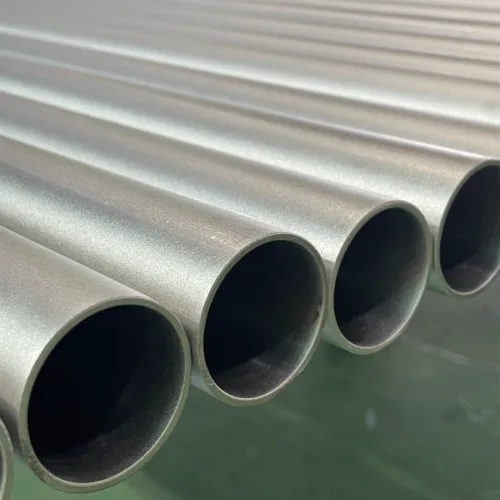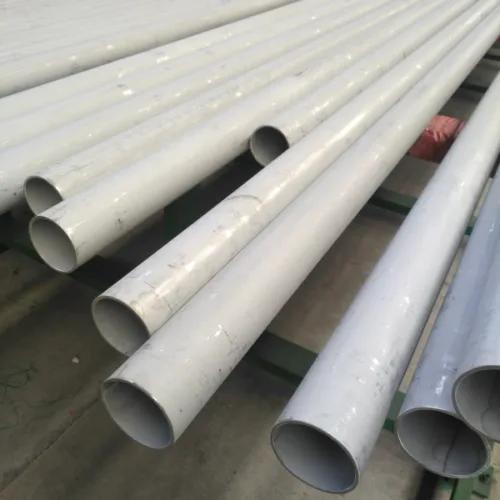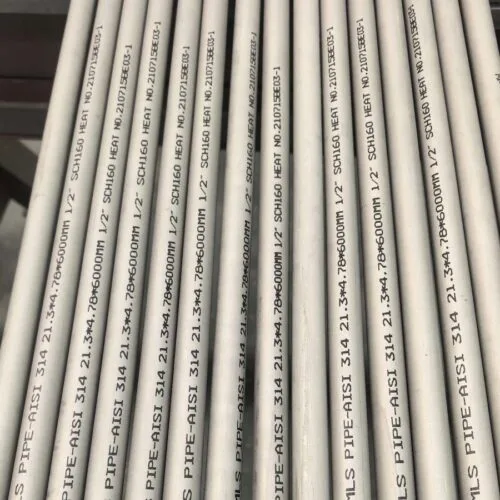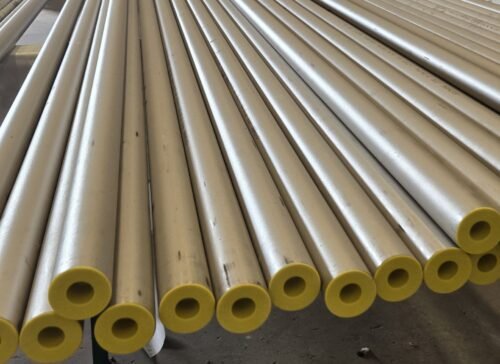
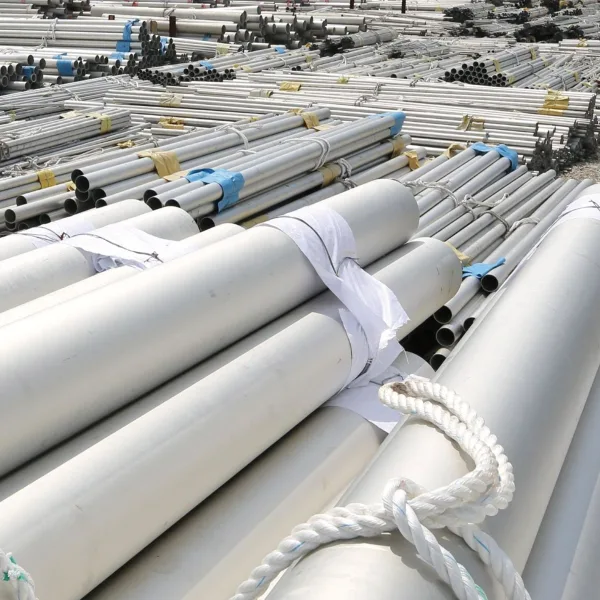
Seamless Stainless Steel TP321H Pipe (UNS S32109) – High-Temperature Structural Solution
TP321H (UNS S32109) is the high-carbon 321 — 0.04–0.10 % C, W.Nr. 1.4878 — supplied as seamless pipe to ASTM A312 / ASME SA312. That carbon range is what gives it creep and rupture strength above 500 °C, and the grade normally carries a grain-size requirement and a solution anneal at 2000 °F [1100 °C] minimum for cold-finished pipe, or 1925 °F [1050 °C] minimum for hot-finished pipe. Give NPS and schedule, design metal temperature and the required grain size.
As the high-carbon version of Grade 321 stainless steel, the “H” designation indicates a controlled carbon range of 0.04% – 0.10%, which significantly improves creep rupture strength and high-temperature load-bearing capacity.
Seamless manufacture removes the longitudinal weld seam. Grain structure, pressure capability and fatigue performance depend on processing, heat treatment, inspection, dimensions and the applicable design code.
Key Features and Technical Advantages
Enhanced Creep Rupture Strength
The increased carbon content improves resistance to creep deformation and rupture, making TP321H ideal for continuous high-temperature service in critical systems.
Titanium Stabilization (Anti-IGC Protection)
Titanium (Ti) binds with carbon to limit chromium carbide precipitation, greatly reducing the risk of intergranular corrosion (IGC) during welding and high-temperature exposure.
Excellent Oxidation and Scaling Resistance
TP321H offers stable performance in oxidizing environments up to 870°C (1600°F), ensuring long-term durability in harsh thermal conditions.
Seamless Structural Integrity
The absence of a longitudinal weld seam removes the weld joint from pressure design, so the pipe can be considered for service under high internal pressure and cyclic thermal stress.
321H Pipe Specifications and Data
For 321H process piping, define grain-size and processing evidence, the applicable product specification and edition, dimensional basis, corrosion allowance where required by the design, end preparation and traceability. A nominal schedule alone does not establish an allowable working pressure.
Equivalent Grade
| UNS | Common grade name | EN material number | EN steel name | JIS grade | GB/T grade |
|---|---|---|---|---|---|
| S32109 | 321H | 1.4940 (approx.) | X7CrNiTi18-10 | SUS 321H | 07Cr19Ni11Ti |
Grade correspondence does not make ASTM, ASME, EN, JIS and GB delivery requirements interchangeable. Confirm chemistry, heat treatment, mechanical properties, dimensions, testing and certification against the purchase specification. See the grade designation index.
Chemical Composition
The composition of Stainless Steel 321H is carefully balanced to achieve its superior high-temperature strength and corrosion resistance.
| Cr | Ni | P | S | Ti | Mn | Si | C |
|---|---|---|---|---|---|---|---|
| 17.00 – 19.00 | 9.00 – 12.00 | ≤ 0.045 | ≤ 0.030 | 4×(C+N)–0.70 | ≤ 2.00 | ≤ 1.00 | 0.04 – 0.10 |
Data source: ASTM A312-25 / ASME SA312 Table 1, TP321H row ≤ heat-analysis acceptance limits. Confirm the values against the ordered edition and the MTC.
Mechanical Requirements (ASTM A312/A312M-25, Table 4 — tensile, yield and elongation)
Stainless Steel 321H is specifically designed to maintain its strength and shape in high-temperature, high-stress environments.
| Property | Value (Annealed) |
|---|---|
| Tensile Strength | ≥ 515 MPa (t ≤ 9.50 mm) / ≥ 480 MPa (t > 9.50 mm) |
| Yield Strength | ≥ 205 MPa (t ≤ 9.50 mm) / ≥ 170 MPa (t > 9.50 mm) |
| Elongation | ≥ 35% |
| Hardness | ≤ 192 HBW |
Note: Tensile, yield and elongation minima are from ASTM A312/A312M-25, Table 4 (elongation 35 % longitudinal, 25 % transverse) and are acceptance requirements, not design allowables. Hardness limits shown are not specified in A312 Table 4 — state any hardness requirement in the order. Mechanical properties are reported on the MTC against the ordered standard, product form, condition and test temperature.
Typical Physical Properties
These physical properties highlight the material’s ability to perform reliably under a wide range of conditions.
| Property | Value |
|---|---|
| Density | 8.0 g/cm3 |
| Melting Point | 1398 -1454 °C |
| Thermal Expansion | 16.6 μm/m·°C (20-100°C) |
| Thermal Conductivity | 16.3 W/m·K (20°C) |
| Modulus of Elasticity | 193 GPa |
| Electrical Resistivity | 0.72 × 10⁻⁶ Ω·m (20°C) |
Note: Density, melting point, thermal expansion, conductivity, modulus and resistivity are typical reference values, not ASTM A312 acceptance limits. Mechanical properties are reported on the MTC against the ordered standard, product form and condition.
Size Tolerance Chart (A999/A999M-24a, in.)
| NPS Designator (Inches) | Permissible Variations in Outside Diameter (Inches) |
| 1⁄8 to 1 1⁄2, inclusive | Over: 1⁄64 in. (0.015 in.) |
| Under: 1⁄32 in. (0.031 in.) | |
| Over 1 1⁄2 to 4, inclusive | Over: 1⁄32 in. (0.031 in.) |
| Under: 1⁄32 in. (0.031 in.) | |
| Over 4 to 8, inclusive | Over: 1⁄16 in. (0.062 in.) |
| Under: 1⁄32 in. (0.031 in.) | |
| Over 8 to 18, inclusive | Over: 3⁄32 in. (0.093 in.) |
| Under: 1⁄32 in. (0.031 in.) | |
| Over 18 to 26, inclusive | Over: 1⁄8 in. (0.125 in.) |
| Under: 1⁄32 in. (0.031 in.) | |
| Over 26 to 34, inclusive | Over: 5⁄32 in. (0.156 in.) |
| Under: 1⁄32 in. (0.031 in.) | |
| Over 34 to 48, inclusive | Over: 3⁄16 in. (0.187 in.) |
| Under: 1⁄32 in. (0.031 in.) |
Values are reproduced from the inch-pound tables of ASTM A999/A999M-24a, which A312 invokes for dimensions; multiply by 25.4 for millimetres. Welded-pipe rows are omitted because this product is seamless.
Tolerance basis: permitted variations per the governing specification stated on this page and the applicable general-requirements standard (ASTM A999 / ASME SA999) for the ordered product form; the wall-thickness and length variations in this section follow the same basis.
Wall Thickness (WT) Tolerance
The wall thickness tolerances are defined by the nominal wall thickness (t) and the outside diameter (D).
1. Minimum Wall Thickness
The minimum wall thickness at any point on the pipe shall not be more than 12.5% under the nominal (specified) wall thickness.
2. Maximum Wall Thickness (Percentage Over Nominal)
The maximum allowable wall thickness variation depends on the size and the t/D ratio (ratio of nominal wall thickness to ordered outside diameter):
| NPS Designator (Inches) | t/D Ratio | Permissible Variation (Over Nominal WT) |
| 1/8 to 2½, inclusive | All ratios | +20.0% |
| 3 to 18, inclusive | t/D ≤ 5% | +22.5% |
| 3 to 18, inclusive | t/D >5% | +15.0% |
| 20 and larger (Seamless) | t/D ≤ 5% | +22.5% |
| 20 and larger (Seamless) | t/D >5% | +15.0% |
Length Tolerance
For pipe ordered to a Specific Cut Length, the standard tolerance is +1/4 in. [6 mm], -0 in. [0 mm].
Pipe is typically supplied in Single Random Lengths (17 to 24 ft) or Double Random Lengths (38 to 40 ft), unless otherwise specified.
Disclaimer: These tolerances are based on ASTM A999/A999M general dimensional requirements commonly referenced by ASTM A312 and ASTM A790. The full and most current specification document must always be consulted for official design and procurement purposes.
Typical Industrial Applications
Thanks to its superior high-temperature strength and corrosion resistance, TP321H is widely used in:
Aerospace Industry
Jet engine components, exhaust manifolds, and afterburner liners requiring thermal fatigue resistance.
Petrochemical & Refining
High-temperature piping systems in catalytic cracking units and hydrotreating processes.
Power Generation
Superheater tubes, boiler headers, and steam pipelines in supercritical and ultra-supercritical plants.
Environmental & Waste Treatment
Thermal oxidizers and recuperators handling high-temperature corrosive gases.
Quality Assurance, Testing & Certification
Each TP321H seamless pipe is delivered with full traceability and comprehensive inspection documentation:
Manufacturing Standards and Compliance
TP321H seamless pipes are produced in accordance with major international standards, ensuring compatibility with global engineering projects:
- ASTM A312 / ASME SA312 – Seamless austenitic stainless steel pipes
- ASTM A213 / ASME SA213 – Boiler and heat exchanger tubes
- EN 10216-5 – Seamless pressure tubes (European standard)
- JIS G3459 / JIS G3463 – Japanese industrial standards
Material Certification
- EN 10204 3.1 Material Test Certificates (MTC) as standard; 3.2 by arrangement
Non-Destructive Testing (NDT)
- Ultrasonic Testing (UT) or Eddy Current Testing (ET), as specified on the purchase order
Material Verification
- Positive Material Identification (PMI)
Corrosion Testing
- Intergranular Corrosion (IGC) test per ASTM A262 Practice E
Mechanical Testing
- Flattening, flaring, bend, and hardness tests
Third-Party Inspection
Available on request through SGS, BV, TUV, ABS, or other authorized bodies
Frequently asked questions
Why does TP321H pipe require controlled carbon rather than simply a maximum carbon limit?
The H grade needs a controlled carbon range because its high-temperature material condition depends on more than avoiding an excessive carbon level. A312/A312M-25 specifies 0.04–0.10% C for TP321H. A heat below the lower limit cannot be accepted as TP321H solely because it is titanium-stabilized or has favorable room-temperature tensile results.
Which grain-size and solution-treatment records establish the ordered TP321H pipe condition?
Require final heat-treatment identification and a grain-size result linked to the tested material lot. A312/A312M-25 specifies ASTM No.7 or coarser for TP321H and distinguishes cold-finished from hot-finished annealing requirements. Record the processing route; a generic 1050°C minimum statement does not establish compliance with the cold-finished condition.
How should TP321H and TP347H pipe be compared for the specified design metal temperature and service life?
Compare both grades using the applicable code allowables, actual metal temperature, design life, atmosphere and fabrication requirements. TP321H uses titanium stabilization, while TP347H uses niobium-based stabilization; neither difference alone determines the better material. Include weld performance and long-term damage mechanisms rather than choosing from equal room-temperature tensile minima or a simple stabilizer ranking.
What welding and thermal-cycle risks should be reviewed for TP321H high-temperature piping?
Review weld heat-affected-zone behavior, residual stresses, restraint and the subsequent operating thermal cycles. Qualify the weld and any required post-weld treatment for the actual thick section and high-temperature duty. Controlled carbon and stabilization do not eliminate fabrication cracking or service damage, and an unqualified stress-relief cycle may change the intended condition.
Which code allowable stresses and long-term material data are needed to design TP321H pipe walls?
Use code-approved allowable stresses for the exact grade, product form and condition at design temperature, with the required creep or rupture design basis where applicable. Include tolerances, allowances, sustained loads and thermal cycles. Room-temperature yield or tensile strength is an acceptance property, not a direct basis for extrapolating the wall of TP321H hot piping.
Ready to Request a Quotation?
Send the NPS and schedule (or actual OD and wall), quantity, length, end finish and the inspection items you need as acceptance criteria — you will get a written quotation stating the specification and edition, delivery condition, documents included and lead time.
For the same grade in tube form, see the TP321H seamless tube. To compare other grades and size combinations, browse the Stainless Steel Seamless Tube category. Minimum order quantity and lead time are confirmed on enquiry against the ordered grade, size and quantity.