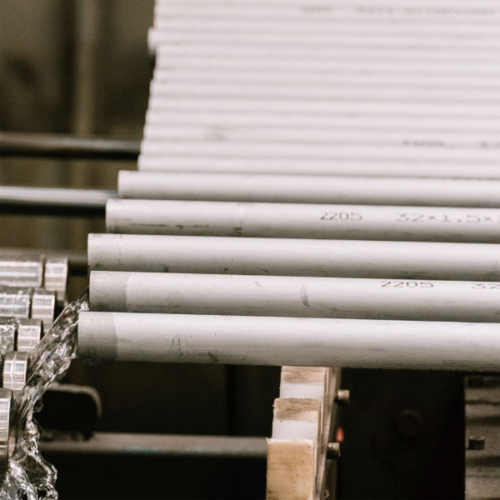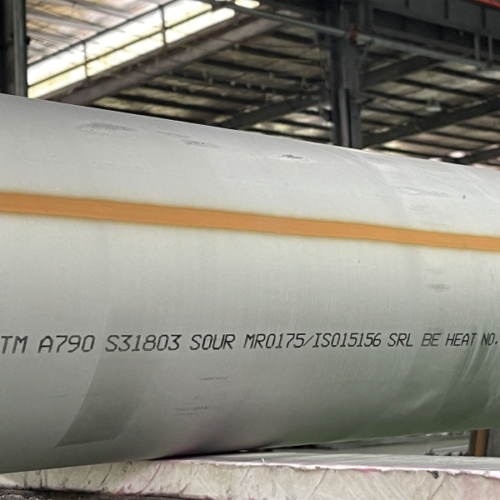
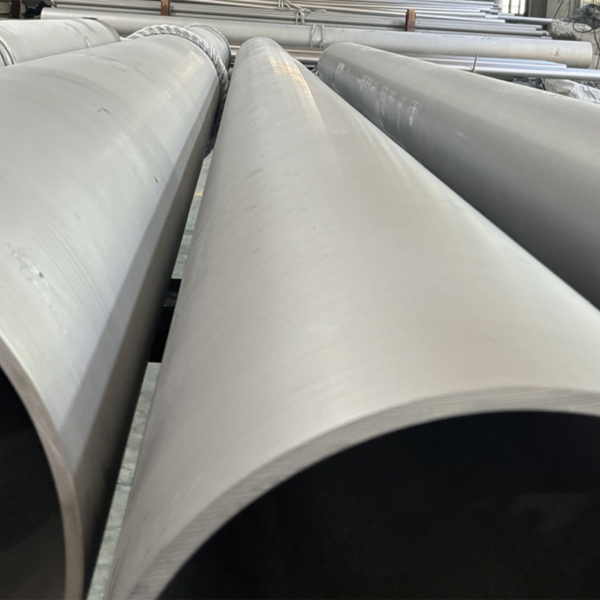
Seamless UNS S31500 Duplex Stainless Steel Pipe Technical Overview, Properties & Specifications
UNS S31500 (also known as 3RE60) is a lean duplex stainless steel engineered to bridge the performance and cost gap between conventional austenitic grades (such as 304/316) and standard duplex grades like S31803.
Aseamless UNS S31500 pipe is produced from a solid billet without any weld seam, ensuring superior structural integrity and reliability under high-pressure conditions.
Itsduplex microstructure (≈50% ferrite + 50% austenite)provides:
High mechanical strength
Excellent resistance to chloride-induced stress corrosion cracking (SCC)
Improved fatigue performance compared to austenitic stainless steels
Key Advantages of Seamless UNS S31500 Pipe
1. High Strength Performance
UNS S31500 offers approximately 2× the yield strength of 300-series stainless steels, enabling:
Reduced wall thickness
Lower material weight
Cost-efficient system design
2. Enhanced Corrosion Resistance
Designed for aggressive environments, it provides strong resistance to:
Pitting corrosion
Crevice corrosion
Chloride stress corrosion cracking (SCC)
3. Cost-Effective Alloy Design
As a lean duplex grade, S31500 contains reduced levels of nickel and molybdenum, resulting in:
Lower alloy cost
Reduced sensitivity to raw material price fluctuations
Stable long-term supply economics
4. Seamless Structural Integrity
The absence of weld seams eliminates potential weak points, making it ideal for:
High-pressure piping systems
Heat exchanger tubing
Critical process applications
Product Specifications and Data
To provide a comprehensive overview of this high-performance material, here are the detailed technical specifications and performance data for UNS S31500 Duplex Steel.
Equivalent Grade
The table below maps UNS S31500 (3RE60) to its equivalent designations in EN, JIS, GB and other international material classification standards.
| UNS | Common grade name | EN material number | EN steel name | JIS grade | GB/T grade |
|---|---|---|---|---|---|
| S31500 | 3RE60 | 1.4424 | X2CrNiMoSi18-5-3 | Not confirmed | Not confirmed |
Grade correspondence does not make ASTM, ASME, EN, JIS and GB delivery requirements interchangeable. Confirm chemistry, heat treatment, mechanical properties, dimensions, testing and certification against the purchase specification.
Chemical Composition
Chemical requirements per ASTM A790/A790M-24 Table 1 (identical to ASTM A789/A789M-24 Table 1). Single values are maximum content unless a range is indicated. In this table the S31500 row carries no Cu requirement; the ellipses (…) mean no minimum is specified and the element need not be determined or reported.
| Grade | C | Mn | P | S | Si | Ni | Cr | Mo | N | Cu | Others |
|---|---|---|---|---|---|---|---|---|---|---|---|
| 31803 | ≤ 0.03 | ≤ 2.00 | ≤ 0.03 | ≤ 0.02 | ≤1.00 | 4.50-6.50 | 21.00-23.00 | 2.50-3.50 | 0.08-0.20 | — | — |
| 32205 | ≤ 0.03 | ≤ 2.00 | ≤ 0.03 | ≤ 0.02 | ≤1.00 | 4.50-6.50 | 22.00-23.00 | 3.00-3.50 | 0.14-0.20 | — | — |
| 31500 | ≤ 0.03 | 1.20-2.00 | ≤ 0.03 | ≤ 0.03 | 1.40-2.00 | 4.20-5.20 | 18.00-19.00 | 2.50-3.00 | 0.05-0.10 | — | — |
| 32550 | ≤ 0.04 | ≤1.50 | ≤ 0.04 | ≤ 0.03 | ≤1.00 | 4.50-6.50 | 24.00-27.00 | 2.90-3.90 | 0.10-0.25 | 1.50-2.50 | — |
| 32750 | ≤ 0.03 | ≤ 1.20 | ≤0.035 | ≤ 0.02 | ≤ 0.80 | 6.00-8.00 | 24.00-26.00 | 3.00-5.00 | 0.24-0.32 | ≤ 0.50 | — |
| 32760 | ≤ 0.05 | ≤1.00 | ≤0.030 | ≤ 0.01 | ≤1.00 | 6.00-8.00 | 24.00-26.00 | 3.00-4.00 | 0.20-0.30 | 0.50-1.00 | W 0.50-1.00; Cr+3.3Mo+16N ≥ 40 |
| 32950 | ≤ 0.03 | ≤ 2.00 | ≤0.035 | ≤ 0.01 | ≤ 0.60 | 3.50-5.20 | 26.00-29.00 | 1.00-2.50 | 0.15-0.35 | — | — |
| 32906 | ≤ 0.03 | 0.80-1.50 | ≤0.030 | ≤ 0.03 | ≤ 0.80 | 5.80-7.50 | 28.00-30.00 | 1.50-2.60 | 0.30-0.40 | ≤ 0.80 | — |
Mechanical Requirements
Minimum tensile and hardness requirements for UNS S31500 in the solution-annealed condition, per ASTM A790/A790M Table 3 (identical to ASTM A789/A789M Table 4). These are specification minima, not typical values from a single heat.
| Tensile Strength, min | Yield Strength, min | Elongation | Hardness |
|---|---|---|---|
| ≥ 630 MPa (92 ksi) | ≥ 440 MPa (64 ksi) | ≥ 30% | ≤ 290 HBW |
Typical Physical Properties
These physical properties highlight the material’s ability to perform reliably under a wide range of conditions.
| Density | Melting Point | Thermal Expansion | Thermal Conductivity | Modulus of Elasticity | Electrical Resistivity |
|---|---|---|---|---|---|
| 7.7 g/cm3 | 1450 – 1510 °C approx. | 13.0 μm/m.°C (20-100°C) | 18.0 W/m·K (20°C) | 200 GPa | 0.85 × 10⁻⁶ Ω·m (20°C) |
Size Tolerance Chart (inches)
| NPS Designator (Inches) | Permissible Variations in Outside Diameter (Inches) |
| 1⁄8 to 1 1⁄2, inclusive | Over: 1⁄64 in. (0.015 in.) |
| Under: 1⁄32 in. (0.031 in.) | |
| Over 1 1⁄2 to 4, inclusive | Over: 1⁄32 in. (0.031 in.) |
| Under: 1⁄32 in. (0.031 in.) | |
| Over 4 to 8, inclusive | Over: 1⁄16 in. (0.062 in.) |
| Under: 1⁄32 in. (0.031 in.) | |
| Over 8 to 18, inclusive | Over: 3⁄32 in. (0.093 in.) |
| Under: 1⁄32 in. (0.031 in.) | |
| Over 18 to 26, inclusive | Over: 1⁄8 in. (0.125 in.) |
| Under: 1⁄32 in. (0.031 in.) | |
| Over 26 to 34, inclusive | Over: 5⁄32 in. (0.156 in.) |
| Under: 1⁄32 in. (0.031 in.) | |
| Over 34 to 48, inclusive | Over: 3⁄16 in. (0.187 in.) |
| Under: 1⁄32 in. (0.031 in.) |
The wall thickness tolerances are defined by the nominal wall thickness (t) and the outside diameter (D).
1. Minimum Wall Thickness
The minimum wall thickness at any point on the pipe shall not be more than {12.5%} under the nominal (specified) wall thickness.
2. Maximum Wall Thickness (Percentage Over Nominal)
The maximum allowable wall thickness variation depends on the size and the t/D ratio (ratio of nominal wall thickness to ordered outside diameter):
| NPS Designator (Inches) | t/D Ratio | Permissible Variation (Over Nominal WT) |
| 1/8 to 2, inclusive | All ratios | +20.0% |
| 3 to 18, inclusive | t/D ≤ 5% | +22.5% |
| 3 to 18, inclusive | t/D >5% | +15.0% |
| 20 and larger (Seamless) | t/D ≤ 5% | +22.5% |
| 20 and larger (Seamless) | t/D >5% | +15.0% |
| 20 and larger (Welded) | All ratios | +17.5% |
For pipe ordered to a Specific Cut Length, the standard tolerance is +1⁄8 in. [3.2 mm], -0 in. [0 mm].
Pipe is typically supplied in Single Random Lengths (17 to 24 ft) or Double Random Lengths (38 to 40 ft), unless otherwise specified.
Disclaimer: These tolerances are based on the common requirements found in ASTM A790, primarily through its reference to ASTM A999. The full and most current specification document must always be consulted for official design and procurement purposes.
Typical Applications
Seamless UNS S31500 duplex pipes are widely used in demanding industrial environments:
Petrochemical & Refining
Process piping
Heat exchanger tubes
Pulp & Paper Industry
Digesters
Bleaching systems
Chemical liquor tanks
Marine & Offshore Engineering
Subsea pipelines
Seawater handling systems
Shipboard piping
Chemical Processing
Organic acid transport
Chloride-containing media
Quality Assurance & Inspection
To ensure full compliance and traceability, the following quality controls are typically applied:
Certification
EN 10204 3.1 / 3.2 Material Test Certificates
Non-Destructive Testing (NDT)
100% PMI (Positive Material Identification)
Ultrasonic Testing (UT)
Eddy Current Testing (ET)
Mechanical Testing
Flattening test
Flaring test
Bend test
Intergranular corrosion (IGC) test
Third-Party Inspection (Optional)
TÜV
BV
SGS
Lloyd’s Register
Ready to Request a Quotation?
Send the NPS and schedule (or actual OD and wall), quantity, length, end finish and the inspection items you need as acceptance criteria — you will get a written quotation stating the specification and edition, delivery condition, documents included and lead time.