
Incoloy vs Inconel: Key Differences Between Two Nickel Alloy Pipes
Incoloy vs Inconel: Key Differences Between Two Nickel Alloy Pipes In high-temperature and corrosive industrial environments, choosing the correct nickel alloy pipe material is essential for ensuring long service life and system safety. Two of the most widely used nickel-based alloys are Incoloy and Inconel. Although both alloys belong to the family of nickel-based austenitic superalloys, their chemical compositions, mechanical performance, and industrial applications differ significantly. Understanding the difference between Incoloy and Inconel pipes helps engineers select the best material for industries such as oil & gas, petrochemical processing, aerospace, marine engineering, and power generation. What Is Inconel? Inconel is a family of nickel-chromium-based superalloys known for their exceptional resistance to extreme heat,…
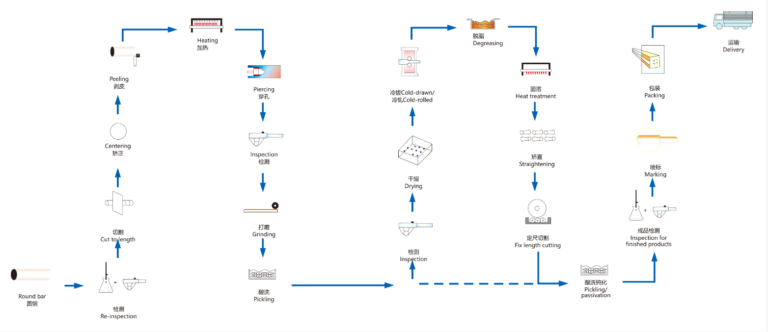
PROCESS FLOW CHART OF SEAMLESS STAINLESS STEEL PIPES
Step-by-Step Stainless Steel Seamless Pipe Manufacturing Process All the steps have been explained in detail below: 1. Round Bar Selection This is the first step towards manufacturing seamless products at Xintongda. We select a strong round bar or a billet of the required grade. As we have to produce the products without any weld seams, we select the best round bars. 2. Re-inspection Once we select the round bar, we send it for re-inspection to check the quality and purity of the bar. 3. Cut to Length The round bar is then cut to a specific length or the maximum…
Why 304 Stainless Steel Pipes Dominate the Global Market: A Technical & Economic Analysis
In the modern industrial landscape, AISI 304 stainless steel (UNS S30400) is the undisputed “King of Usage.” Whether it is for high-precision sanitary tubing, industrial heat exchangers, or architectural structural components, the 304 grade remains the industry standard. But what specific properties make this Austenitic stainless steel the “Hexagon Warrior” of materials? Below, we analyze the technical and economic factors driving its global dominance. 1. The “Golden Ratio” of Chemical Composition The performance of 304 stainless steel is rooted in its chemistry, specifically the 18/8 ratio (18% Chromium and 8% Nickel). 2. Exceptional Fabricability and Weldability One of the primary reasons for the widespread adoption of…
Incoloy vs Inconel: Key Differences Between Two Nickel Alloy Pipes
Incoloy vs Inconel: Key Differences Between Two Nickel Alloy Pipes In high-temperature and corrosive industrial environments, choosing the correct nickel alloy pipe material is essential for ensuring long service life and system safety. Two of the most widely used nickel-based alloys are Incoloy and Inconel. Although both alloys belong to the family of nickel-based austenitic superalloys, their chemical compositions, mechanical performance, and industrial applications differ significantly. Understanding the difference between Incoloy and Inconel pipes helps engineers select the best material for industries such as oil & gas, petrochemical processing, aerospace, marine engineering, and power generation. What Is Inconel? Inconel is a family of nickel-chromium-based superalloys known for their exceptional resistance to extreme heat,…