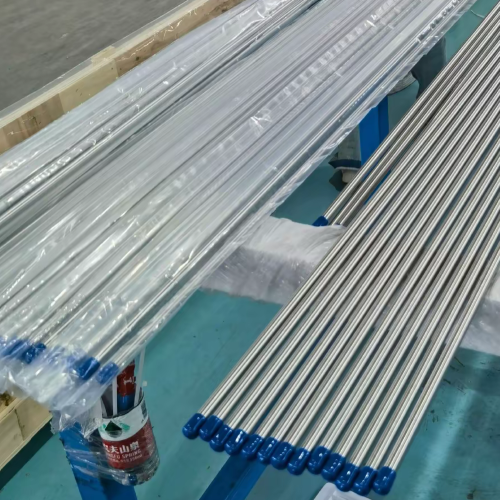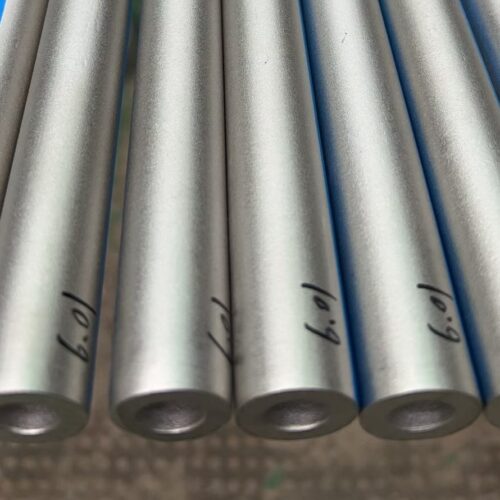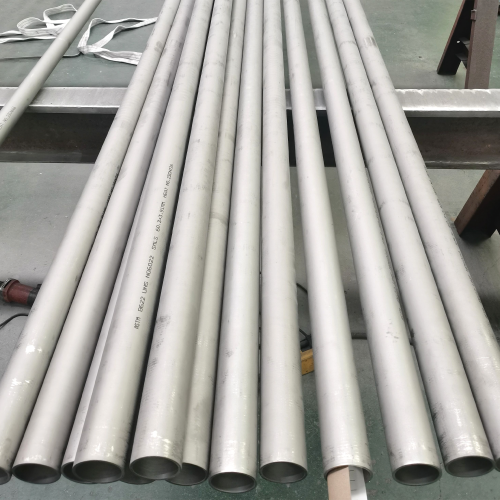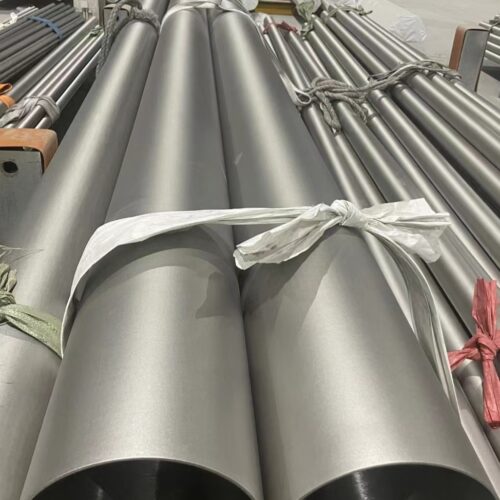
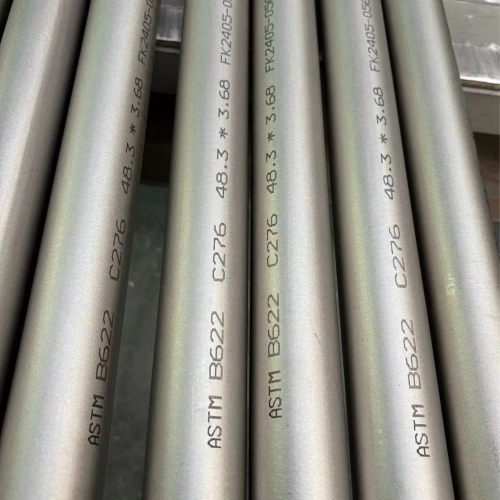
What Is a Seamless Hastelloy C276 Tube?
Seamless Hastelloy C276 Tube — UNS N10276 — is a nickel–molybdenum–chromium–tungsten alloy (15.0–17.0% Mo, 14.5–16.5% Cr, 3.0–4.5% W, carbon controlled to 0.010% maximum) produced to ASTM B622 from a solid billet with no weld seam.
C276 is the most versatile of the Ni–Cr–Mo alloys: it withstands wet chlorine gas, hypochlorite and chlorine dioxide, and resists pitting and crevice attack in oxidizing chlorides while remaining excellent in reducing acids such as dilute hydrochloric and sulfuric acid. The tight carbon limit keeps the welded structure free of grain-boundary carbides, so as-welded equipment can be used in most chemical process environments.
Key Features and Advantages
Seamless UNS N10276 tube is the all-round Ni-Cr-Mo-W alloy for mixed reducing and oxidizing chemical service:
Versatility Across Reducing and Oxidizing Media: the balanced Mo-Cr-W system handles hydrochloric, sulfuric, phosphoric and acetic acids as well as wet chlorine and hypochlorite.
Outstanding Pitting and Crevice Resistance: 15.0–17.0% Mo with 3.0–4.5% W gives a very high resistance to localized attack in chloride-bearing streams.
Carbon Limited to 0.010%: prevents grain-boundary carbide precipitation during welding, preserving corrosion performance in the as-welded condition.
High Strength in the Solution Annealed State: tensile 690 MPa (100 ksi) minimum with yield 283 MPa (41 ksi) minimum and 40% elongation per ASTM B622.
Proven in the Harshest Plants: more than five decades as the reference alloy for flue gas desulfurization, acid coolers and pulp-bleaching equipment.
Product Specifications and Data
To provide a comprehensive overview of this high-performance material, here are the detailed technical specifications and performance data for UNS N10276 seamless tube.
Equivalent Grade
| UNS | Common grade name | EN material number | EN steel name | JIS grade | GB/T grade |
|---|---|---|---|---|---|
| N10276 | Hastelloy C-276 | 2.4819 | NiMo16Cr15W | NW0276 | NS3304 / NS334 (legacy) |
Grade correspondence does not make ASTM, ASME, EN, JIS and GB delivery requirements interchangeable. Confirm chemistry, heat treatment, mechanical properties, dimensions, testing and certification against the purchase specification. Approximate or unconfirmed correspondences retain their qualification. See the grade designation index.
Chemical Composition
UNS N10276 seamless tube chemistry is tightly controlled so the corrosion and mechanical performance below is repeatable:
| Grade | Ni | Mo | Cr | Fe | W | Co | Mn | V | C | Si | P | S |
|---|---|---|---|---|---|---|---|---|---|---|---|---|
| UNS N10276 | remainder | 15.0–17.0 | 14.5–16.5 | 4.0–7.0 | 3.0–4.5 | ≤2.50 | ≤1.00 | ≤0.35 | ≤0.010 | ≤0.08 | ≤0.04 | ≤0.03 |
Chemical requirements per ASTM B622-23, Table 1. Single values are maximum content unless a range is indicated. Nickel is determined arithmetically by difference (remainder); the combination of 15.0–17.0% molybdenum, 14.5–16.5% chromium and 3.0–4.5% tungsten is what makes C276 effective in both reducing and oxidizing media.
Typical Mechanical Properties
Values below are specification minimums for the delivery condition; they define the acceptance basis for UNS N10276 seamless tube.
| Condition | Tensile Strength, min, ksi (MPa) | Yield Strength (0.2% Offset), min, ksi (MPa) | Elongation in 2 in. or 50 mm, min, % |
|---|---|---|---|
| Solution annealed | 100 (690) | 41 (283) | 40 |
Mechanical properties per ASTM B622-23, Table 2, in the solution annealed and descaled condition (6.2). Each pipe and tube is hydrostatically or nondestructive electrically tested (9.1) per the general requirements of ASTM B829. To avoid sensitization, avoid long-term exposure in the 540–870 °C range where secondary phases can precipitate.
Typical Physical Properties
These physical properties highlight the material’s ability to perform reliably across a range of environments.
| Density | Melting Range | Thermal Expansion | Thermal Conductivity | Modulus of Elasticity | Electrical Resistivity |
|---|---|---|---|---|---|
| 8.87 g/cm3 (ASTM B622) | 1325 – 1370 °C | 11.2 μm/m·°C (20–100°C) | 10.4 W/m·K | 205 GPa | 1.30 μΩ·m (20°C) |
Size Tolerance Chart (mm)
Permissible variations for seamless nickel alloy tube in accordance with ASTM B829-24, Table 2:
| Nominal Outside Diameter, mm | Permissible Variation in OD, mm | Average Wall, % | Minimum Wall |
|---|---|---|---|
| 10.0 to 15.9, excl | ±0.13 | ±15 | +30% / −0 |
| 15.9 to 38.1, incl | ±0.19 | ±10 | +22% / −0 |
| over 38.1 to 76.2, incl | ±0.25 | ±10 | +22% / −0 |
| over 76.2 to 88.9, incl | ±0.38 | ±10 | +22% / −0 |
Notes (dimensions per ASTM B829-24, Table 2, referenced by ASTM B622-23): tolerances apply to individual measurements and include ovality. For thin-wall tube (nominal wall 3% or less of the OD), the mean OD shall comply with the table and individual measurements are increased by 0.5% of the nominal OD. Wall variation in any cross section (eccentricity) shall not exceed ±10% of the actual average wall. B622-23 limits seamless tube to 88.9 mm (3.5 in.) outside diameter; larger hollows are covered as pipe under the same general requirements.
Length Tolerance
- When tube is ordered cut-to-length, length variation is +3.2 mm / −0 for OD under 50.8 mm and +4.8 mm / −0 for larger sizes (ASTM B829-24, Table 5); for lengths over 24 ft, an additional +3.2 mm per 10 ft applies, up to a maximum of +12.7 mm.
- Tube is normally supplied in mill lengths or specific cut lengths as agreed in the order.
Disclaimer: Dimensional data above are summarized from ASTM B829-24, Table 2, as referenced by ASTM B622-23. The full and most current specification documents must always be consulted for official design and procurement purposes.
Common Industrial Applications
The combination of corrosion resistance, mechanical strength and manufacturing quality makes UNS N10276 seamless tube a preferred choice for:
Flue Gas Desulfurization and Pollution Control
Scrubber internals, stacks, dampers and quench tubing in wet acidic gases.
Chemical and Petrochemical Processing
Acid coolers, reactor internals and transfer lines handling mixed acids and chlorides.
Pulp and Paper Bleaching Systems
Tubing for chlorine dioxide, hypochlorite and acidic bleaching stages.
Oil and Gas Sour Service
Downhole and surface components exposed to H2S, CO2 and saline brines.
Manufacturing Process
The manufacturing of UNS N10276 seamless tube is a precise, multi-step process:
- Heating: A solid round billet is heated to the hot-forming temperature.
- Hot Piercing / Extrusion: A piercing mill or extrusion press converts the billet into a hollow shell.
- Cold Pilgering / Drawing: The shell is cold reduced to the ordered OD and wall with tight tolerances and a smooth surface.
- Solution Annealing: tube is supplied solution annealed and descaled (ASTM B622-23, 6.2); typical mill annealing is 1120 – 1175 °C (2050 – 2150 °F) followed by rapid air or water cooling.
- Pickling and Testing: Final tube is pickled, visually inspected, and tested: tension, hardness on every lot, plus hydrostatic or nondestructive electric testing of each length.
Ordering Guide
When specifying UNS N10276 seamless tube, please include: quantity, outside diameter and wall (nominal or minimum), delivery condition, length, and any third-party inspection or supplementary requirements — our sales team will confirm the production schedule and send a formal quotation.
Frequently Asked Questions
What sizes are available for Hastelloy C276 seamless tube?
The overall range is OD 6–257 mm; WT 0.5–35 mm. Requirements outside this range are reviewed against mill capability on request.
Which specification governs Hastelloy C276 seamless tube?
ASTM B622 / ASME SB622 is the governing specification for Hastelloy C276 seamless tube. The edition in force at order time is stated on the quotation and purchase order; chemistry, mechanical properties, heat treatment, dimensions and testing are reported against the ordered standard and material heat.
What inspection documents are provided?
Each order is documented with a mill test certificate stating heat chemistry and mechanical test results. EN 10204 3.1 certification, hydrostatic testing, eddy-current or ultrasonic inspection and PMI are performed when specified in the purchase order.
Ready to Request a Quotation?
Send the NPS and schedule (or actual OD and wall), quantity, length, end finish and the inspection items you need as acceptance criteria — you will get a written quotation stating the specification and edition, delivery condition, documents included and lead time.