
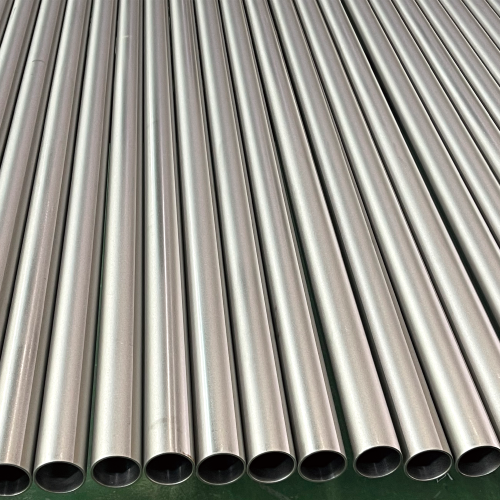
What Is a Seamless Stainless Steel Heat Exchanger Tube?
Seamless Stainless Steel Heat Exchanger Tube is a high-performance cylindrical tube meticulously crafted from a single, solid billet of stainless steel. Unlike welded tubes, it has no weld joint, ensuring superior structural integrity and reliability, especially under high-stress, high-pressure, and corrosive conditions. These tubes are specifically designed to be the core component in heat exchangers, which are devices used to efficiently transfer heat between two or more fluids. The use of high-quality stainless steel provides exceptional resistance to corrosion, high temperatures, and stress, making it an ideal choice for critical applications in various industries.
The seamless heat exchanger tube standards:
• ASTM A 213- Standard specification for seamless, ferritic and austenitic alloy-steel boiler, super heater and heat exchanger tubes.
• ASTM A789- Standard specification for seamless, duplex stainless steel heat exchanger tubing.
• ASTM B161- Nickel seamless pipes and tubes.
• ASTM B163- specification for seamless nickel and nickel alloy condenser and heat exchanger tubing.
• ASTM B167-Nickel-Chromium-Iron alloys and Nickel-ChromiumCobalt-Molybdenum alloy pipes and tubes.
• ASTM B668-standard specification for UNS08028 seamless pipes and tubes.
• EN 10216-5 TC-1 & TC 2, DIN Standards.
Key Features and Advantages of Seamless Stainless Steel Heat Exchanger Tube
Seamless Stainless Steel Heat Exchanger Tube offer a unique combination of benefits that make them invaluable in the most demanding industries:
Exceptional Corrosion Resistance: Stainless steel’s inherent properties provide outstanding resistance to oxidation, pitting, and crevice corrosion, especially in chloride-containing environments.
High Strength and Pressure Tolerance: The seamless construction eliminates a potential weak point, allowing the tube to safely handle high internal and external pressures, which is critical for safety and efficiency.
Superior Heat Transfer Efficiency: The smooth internal and external surfaces of the tube, combined with stainless steel’s thermal properties, facilitate efficient heat exchange and reduce the risk of fouling or scaling.
Excellent Toughness: It maintains good toughness at a wide range of operational temperatures, from cryogenic to elevated heat, making it suitable for diverse applications.
Long-Term Reliability: The absence of a weld seam and the high-quality material ensure enhanced durability and a longer service life, reducing maintenance costs and downtime.
Product Specifications and Data
To provide a comprehensive overview of this high-performance material, here are the detailed technical specifications and performance data for Seamless Stainless Steel Heat Exchanger Tube.
The composition of stainless steel is carefully balanced to achieve its superior corrosion resistance and durability.

Note: All values are maximum percentages unless a range is specified. “5xC min” means the minimum titanium or niobium content must be at least 5 times the carbon content. Actual product analysis may permit slight deviations per ASTM A213 tolerance rules.
Stainless steel is designed to maintain its strength and integrity in challenging operational environments.

Note: For longitudinal strip tests, a deduction from the basic minimum elongation of 1.00% for 18Cr-2Mo, T23, T91, and T122, and 1.50% for all other ferritic grades, shall be made for each 1/32 in. (0.8 mm) decrease in wall thickness below 5/16 in. (8 mm). Hardness limits also apply: most austenitic grades must not exceed 192 HB/200 HV (90 HRB).
ASTM A213 Tolerances
Dimensional tolerances under ASTM A213 govern outside diameter (OD), wall thickness, and cut length. These limits depend on the tube’s OD range and whether the tube is cold-finished or hot-finished. Tighter OD tolerances are specified for cold-drawn tubes, while hot-finished tubes allow wider variation. The tables below outline the standard tolerance limits.

Common Industrial Applications
Due to its exceptional corrosion resistance and mechanical strength, S32760 seamless tubing is widely used in highly demanding industries.
Chemical and Petrochemical Processing
Used in shell and tube heat exchangers, evaporators, and condensers for various corrosive fluids.
Oil and Gas Industry
In refineries and offshore platforms for cooling, heating, and gas processing.
Power Generation
In steam condensers, heat recovery steam generators (HRSG), and feed-water heaters.
Food and Beverage
For hygienic heat exchange in pasteurization and sterilization processes.
Pharmaceuticals
In clean-room environments for process heating and cooling where hygiene and material purity are paramount.
Manufacturing Process of heat exchanger seamless tube
The manufacturing of a Seamless Stainless Steel Heat Exchanger Tube is a precise, multi-step process that ensures the highest quality and performance:
- Heating: A solid billet of stainless steel is heated to a high temperature.
- Piercing: A piercing mill pushes a mandrel through the center of the heated billet to form a hollow shell.
- Drawing and Sizing: The hollow shell is cold-drawn or cold-rolled to precisely reduce its diameter and wall thickness to the required specifications. This process also improves the material’s mechanical properties and surface finish.
- Heat Treatment: The tube is heat-treated to relieve stress and ensure the final product meets specified metallurgical properties.
- Finishing: The tube is then subjected to straightening, cutting to length, and non-destructive testing (such as eddy current or hydrostatic testing) to verify its integrity before final inspection and packaging. This meticulous process ensures that every seamless heat exchanger tube meets the highest standards for performance and reliability.